
West Palm Beach, March 2026. Companion pieces from the same week: USSA Superyacht Summit and MARE Forum.
How do we adopt AI in a way that serves our industry without compromising what makes it exceptional?
For years, there was a dam. Behind it, enormous pressure was building as machine learning matured, compute improved, and model capability quietly compounded. Then in 2022, the dam burst. All of that accumulated capability became accessible to everyone, almost simultaneously, and the industry found itself in a flood. Most businesses went from never thinking about AI to being underwater in information about it, overnight. That feeling of trying to keep your head above the surface, of not knowing where to put your feet, is the most common experience I hear when I sit down with maritime leaders.
What I have come to understand is that the feeling is not a competence problem. It is a structure problem. And structure problems have a structured response.
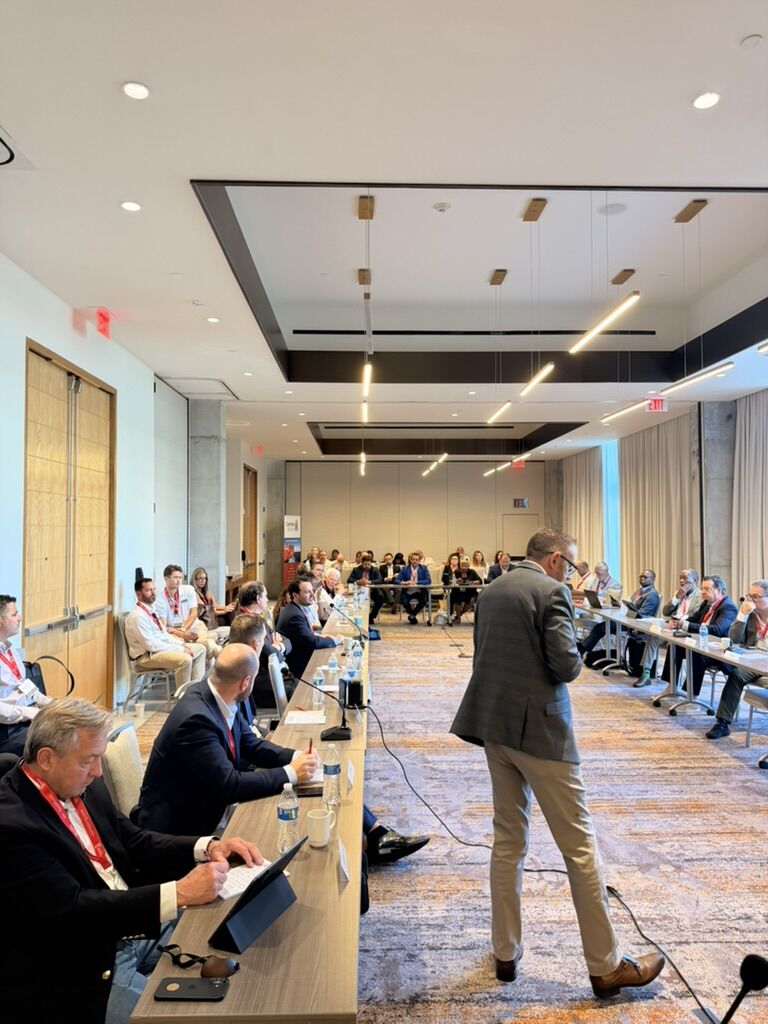
The ISS Education Committee, co-chaired by Pete Southgate and Barrett Wright, brought together Jake Lazarus, Sara Shake, Claire Hagen, Alistair Callender, and Christina Norris in West Palm Beach last month. Across software development, marketing, digital security, brokerage, and design, the panel collectively surfaced five dimensions of AI adoption that every maritime business is navigating right now, whether they have named them or not. The vision gap. The discovery gap. The security gap. The efficiency gap. The accountability gap.
Structured adoption requires holding all five simultaneously. Most organisations are only looking at one or two.
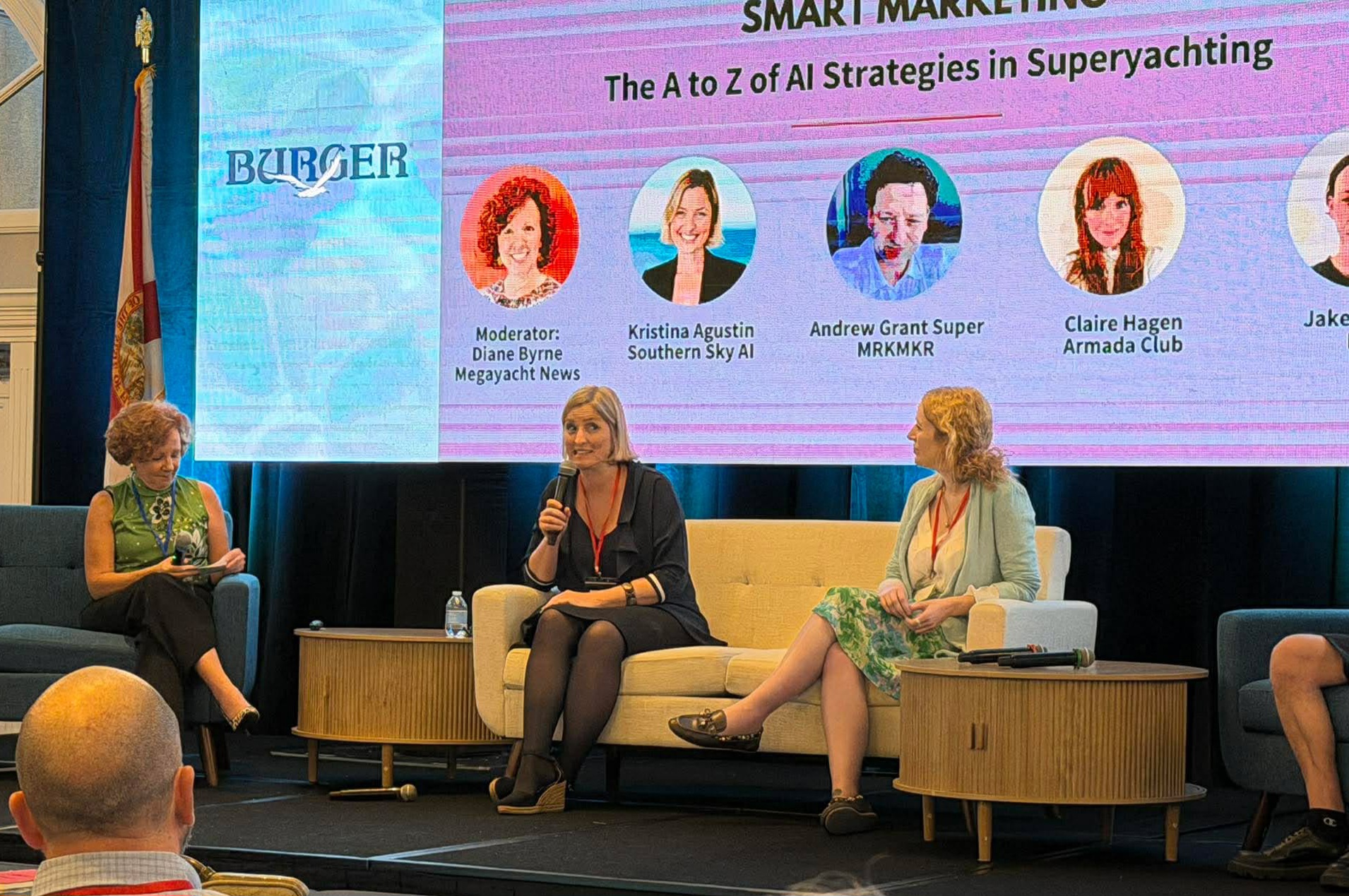
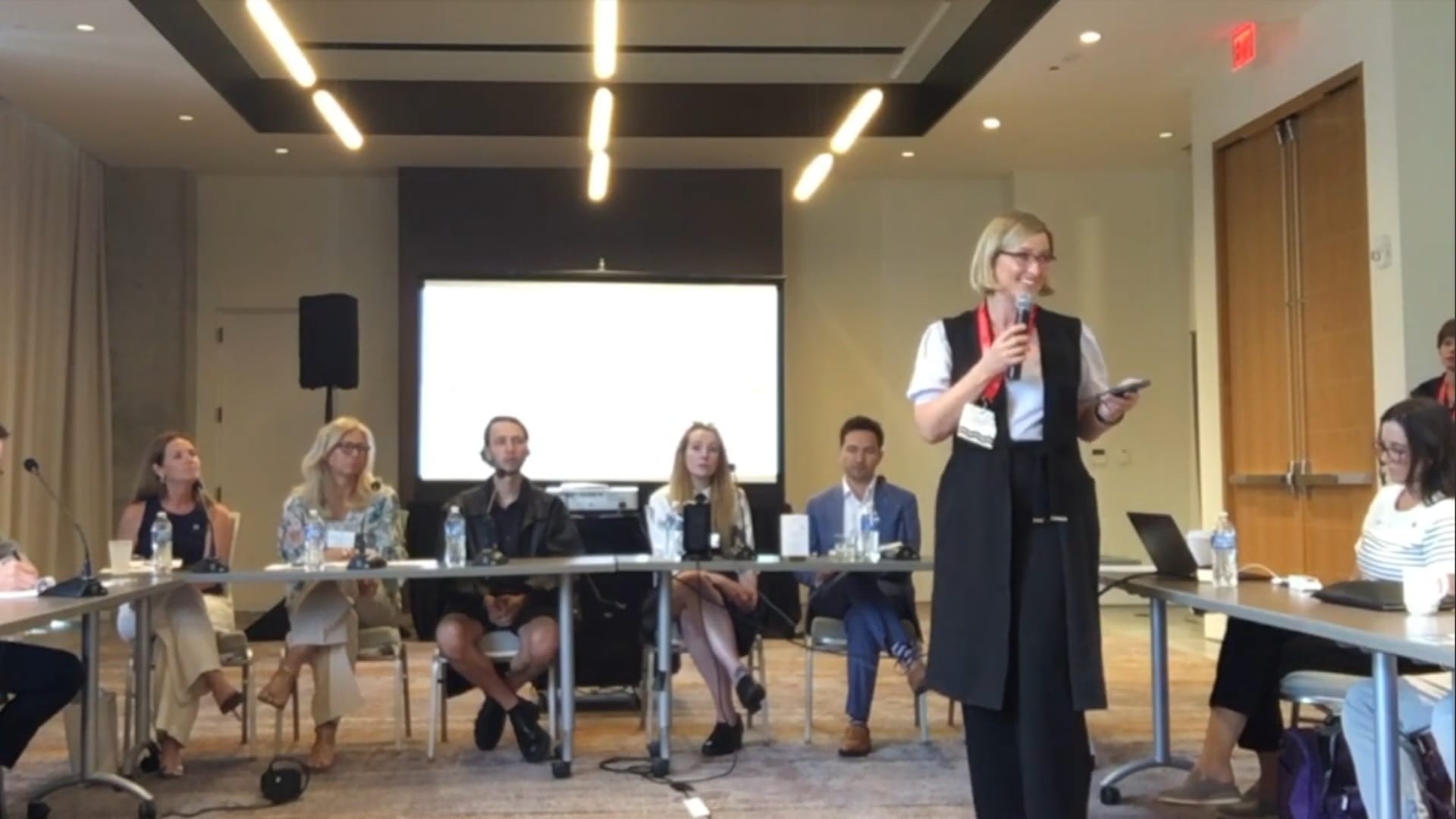
ISS Education Committee Leadership Series: AI in Yachting. Panelists: Jake Lazarus (Fenton Innovation), Sara Shake (Vacancy), Claire Hagen (Armada Club), Alistair Callender (Moravia Yachting), Christina Norris (Oversee Yachts). Moderator: Kristina Agustin (Southern Sky AI). Watch on the ISS YouTube channel
The Vision Gap
Jake Lazarus, Fenton Innovation
The operational foundation has to exist before an AI layer can do anything meaningful. AI is only as capable as the systems connected to it, and a CRM maintained with discipline produces entirely different results from one used inconsistently for years. That sequencing is governance work, not technical work, and it applies whether you are running a yacht management company or a charter brokerage.
The organisations that succeed with AI start from a vision and work backwards. The ones that stall start from a list of objections. That difference shapes everything: what gets budgeted, how staff engage with the change, and the quality of what eventually gets built.
The people that win, the teams that win — they have to want it to work. Don't start with here's the ten things I dislike. Tell us: what do you want? What's the vision? Work backwards from there.
If you had access to an infinite number of PhD graduates today, what would you do with them? The gap between what is possible and what is being implemented in our industry is a vision gap. It closes from the top.
The Discovery Gap
Sara Shake, Vacancy
Search engine optimisation was built on the logic of ranking. That logic is quietly becoming secondary. AI-driven platforms do not return a list of results. They return one answer. The businesses structuring their content and expertise to be that answer now will occupy a fundamentally different position in two years from those who are not.
You're either the answer or you're not. There's no list, there's no page of results. You're either going to be included or you're going to be left out.
For an industry where discretion often means a deliberately low digital profile, this is a live problem. The same instinct that protects client privacy can make a business unrecognisable to the engines now doing research on behalf of high-net-worth buyers, family offices, and charter clients. Specialists are favoured over generalists in AI-driven discovery. The clearer and more specific the positioning, the more likely a business becomes the answer rather than absent from a conversation it never knew was happening.
The way Southern Sky AI is understood by AI systems is something I treat as infrastructure. This conversation is why.
The Security Gap
Claire Hagen, Armada Club
Every professional in this industry has a digital surface, and most have not audited it. The tools being used to research people before meetings, before transactions, before introductions, are publicly available and require no technical skill to operate.
You no longer need to be famous, per se, to be recognised. You need to audit yourself. Know what is online about you and what can be misconstrued.
PimEyes is a facial recognition tool available to anyone. It takes a single photograph and surfaces everything indexed to that face across the open web: conference photos, event coverage, background images from gatherings a person may not remember being photographed at. For an industry built around the privacy and security of some of the most high-profile individuals in the world, the implications are immediate.
We have extensive frameworks around physical security. Photography policies. NDAs. Crew conduct standards developed over decades. The question is whether our digital literacy is keeping pace with the tools being used to gather information before a conversation ever begins.
Claire also named something that functions as a collective vulnerability: when businesses in our industry experience security incidents, they stay quiet, because silence is read as competence and disclosure as weakness. The consequence is that the same vulnerabilities get exploited repeatedly across different organisations because no one shares what they learned. Industries with equally sensitive data and equally powerful clients have moved toward structured information sharing on security threats. Our industry would benefit from the same shift.
The Efficiency Gap
Alistair Callender, Moravia Yachting
Owner conversations about AI have moved from curiosity to specificity. A year ago, the question was: what is AI? Now it is: how can I use it on this programme? That shift is happening across owner demographics, not just among those who come from technology backgrounds.
AI won't replace any people, but it will replace inefficiencies.
AI-assisted design tools compress what used to take weeks into something much shorter. The designer's creativity is not replaced; the time available for it increases. That same logic runs across the full operational spectrum. For yacht managers carrying significant documentation load, for captains managing crew administration, for brokers coordinating complex itineraries, the question is not whether AI applies. It is where the highest-value inefficiencies sit and what it would mean to address them.
The Accountability Gap
Christina Norris, Oversee Yachts
The creative relationship between a designer and a client is built on presence, on reading what is said and what is not, on translating a person's identity into something physical and enduring. That is not a process a model can replicate, and it is not what AI is being asked to do.
The imagination, intuition, inspiration and instinct — that's something that lives in us. That's something that makes us human.
Christina has worked through every wave of design technology, from drawing boards through AutoCAD through 3D rendering to the AI-assisted tools available now. Her question was not whether AI is useful in design. Her question was about what remains irreducibly human in the act of creation, and what responsibility that places on the people making decisions about what gets automated.
AI models are trained on vast bodies of existing work, including designs, drawings, and intellectual property of every kind. As our industry integrates AI-generated outputs into professional deliverables, the question of what we are responsible for and what we owe to the creative lineage we are drawing from will not stay abstract for long. The Library of Congress already requires authors to declare AI involvement in registered works. That framework will reach more industries. Capability is not a mandate. The considered judgment about what should remain human belongs to the people in the room.
Holding All Five
The vision gap, the discovery gap, the security gap, the efficiency gap, the accountability gap. Each one is a real and present challenge for maritime businesses navigating AI adoption right now. Most organisations encounter one of these and treat it as the whole problem. Addressing one without the others leaves the structure incomplete.
Structured adoption means mapping your full terrain before you move. It means knowing where your operational foundation needs strengthening before you add an AI layer, understanding how you are being found and described by systems your clients are already using, auditing your digital surface with the same care you give to physical security, identifying where your highest-value inefficiencies actually sit, and being clear about which decisions require a human being and why.
That discipline is not a brake on adoption. It is what makes adoption durable.
One thread that surfaced across the panel without prompting: several of us have converged on Claude from Anthropic as the primary working tool, across very different use cases. Jake noted it as the clear choice for teams building AI applications. I have since written a dedicated piece on Claude for anyone who wants to understand what distinguishes it and why it has moved so quickly to the front of the field: Why Maritime Professionals Are Moving to Claude.
I am grateful to Pete, Barrett, and the ISS Education Committee for the space to have this conversation, and to every panelist who brought their full perspective to it.
Kristina Agustin is the founder of Southern Sky AI, a structured AI adoption advisory practice for maritime leaders. southernsky.ai