
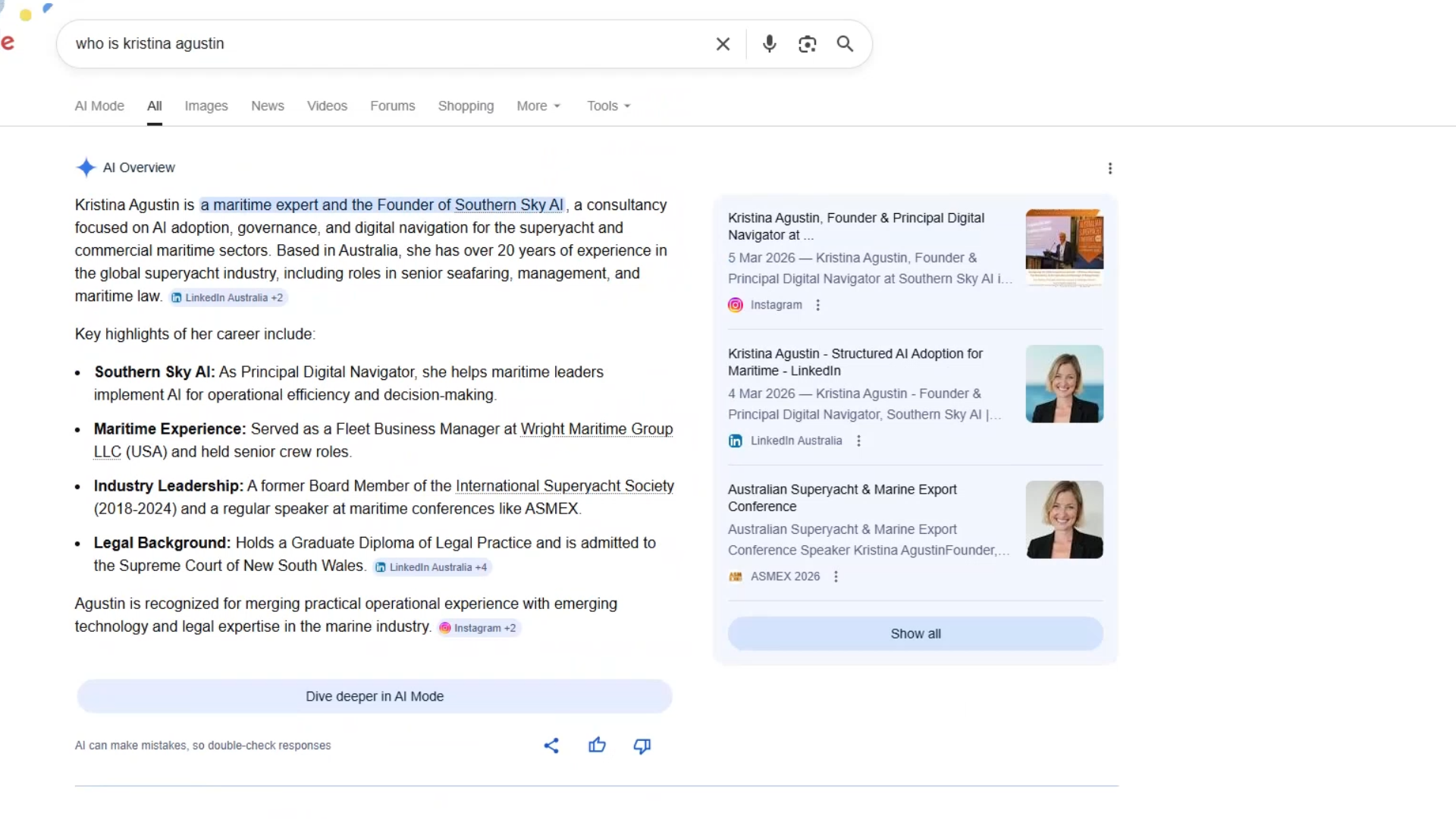
There is another person in the world with my name. For a period she appeared above me in Google results. My family has been treated to a series of screenshots documenting my theatrical outrage at this state of affairs. They find it very funny. I find it a challenge to a digital duel. As of today, Google Gemini cites only me as the real Kristina Agustin. Try it, and if I've been outside it, let me know. My family are going to cop a few more screenshots.
I mention it because it is, underneath the mild absurdity, an Answer Engine Optimisation story. Understanding how AI systems form their picture of an entity, and doing the structural work to make that picture accurate and confident, is what shifted the results. And once the work was complete, the change came through faster than I expected.
Understanding how AI systems form their picture of an entity, and doing the structural work to make that picture accurate and confident, is what shifted the results.
What is Answer Engine Optimisation?
Answer Engine Optimisation, also called GEO (Generative Engine Optimisation) or AI search, is the discipline of structuring your digital presence so that AI systems can understand, trust, and recommend your entity to the right audience.
Traditional SEO operates on a model where a search query returns a list of results and a user clicks through, compares, and browses. The game is ranking. AEO operates in a different environment. When someone asks ChatGPT, Gemini, or Perplexity a question, they receive one synthesised answer, sometimes a short list, rarely a long one. There is no page two. Voice assistants go further still: Alexa gives one answer. You either appear in that response, or you do not appear at all.
The businesses appearing in those AI-generated answers earned their place the same way they earned referrals in any other context: by being clearly understood, consistently credible, and easy to find. The industry has not yet settled on a single term for this discipline, and the precise weighting of signals is not publicly documented. What is consistent across practitioners and researchers working in this space is the underlying structural principle: the machine is looking for confidence, and you build confidence through clarity, consistency, and connection.
From E-E-A-T to entity trust
For years, search engines evaluated content using a framework called E-E-A-T: Experience, Expertise, Authoritativeness, and Trustworthiness. The familiar signals were links from reputable sources, consistent business information across the web, author credentials attached to content, and third-party recognition. Those signals still matter.
What has changed is the layer above them. Traditional search asked: is this content trustworthy? AI systems now ask: is this entity trustworthy, and do we understand it clearly enough to recommend it?
The distinction is consequential. You may be an esteemed and respected maritime leader, with decades of operational experience, genuine industry recognition, and a well-maintained website, and still be effectively invisible to an AI system if the machine cannot connect all of those signals to a single, coherent entity. Credibility signals that cannot be attached to a clearly resolved entity only float, and do not compound.
Credibility signals that cannot be attached to a clearly resolved entity only float, and do not compound.
The three stages the machine moves through
Jason Barnard is a recognised authority on entity optimisation and has developed a structured framework for approaching it. He describes the progression in three stages.
Understandability is the foundation. Does the machine know who you are, what you do, and who you serve? This sounds straightforward. In practice, many entities fail here because they have published subtly different descriptions across platforms, maintained bios that describe a version of their business from two years ago, and built websites that look professional but give the machine nothing consistent to work with about the entity behind them.
Credibility follows understandability, and only once understandability is established. Credentials, speaking engagements, media mentions, directory listings, industry appointments: these signals carry weight. They only carry weight, though, when the machine can attach them to an entity it has already clearly resolved. Credibility floating above an ambiguous or inconsistently described entity only floats and does not compound.
Deliverability is the outcome of the first two stages working together. A machine that is not confident about who you are will not confidently recommend you. Deliverability is earned through the first two stages, not assumed independently of them.
All three must be maintained simultaneously. Strong credibility signals attached to a poorly understood entity produce no benefit.
The hub and spoke model
The structural framework that makes this work in practice is a hub and spoke model.
Your entity home is the hub. For most businesses and practitioners, that is the About page: not the homepage, not the services page. The entity home is the single canonical place where the machine goes to answer its foundational question about who you are. It needs to find there, in one clearly structured place, who you are, what you do, who you serve, and why you are credible.
Every other presence forms a spoke: your LinkedIn personal profile, your company LinkedIn page, your directory listings, media mentions, speaking engagements, scholarly recognition, industry appointments. Each spoke must connect explicitly back to the entity home, and the entity home must link outward to each spoke in return. The machine reads each connection as a separate corroborating signal that your entity is real, active, and consistent.
Every disconnected node creates doubt. Doubt breaks association and loses credibility benefits. The machine must always be able to navigate back to the entity home in as few steps as possible.
For founder-led businesses and solo practitioners, the entity home typically connects one person to one company, and the spokes radiate from that single human anchor. For larger organisations, the same model applies but extends further: the company entity home names and links to key people, and each of those people, as clearly resolved entities in their own right, links back. Think of how a public company is understood not just as a brand but through its leadership: the chief executive, the founder, the subject matter experts who publish and speak publicly. Each person forms their own spoke, and each person's LinkedIn profile, credentials, and published work reinforce the company entity by association. The principle scales. The requirement for consistency does not change with size.
For maritime businesses of any scale, your association memberships, class society relationships, award recognitions, and conference appearances each carry independent weight as credibility signals. Giving each category its own clearly labelled section on your About page, rather than combining them into a single credentials paragraph, lets the machine read each one for what it contributes. Merged categories dilute the signal.
The technical layer
The structural work at the content and profile level is supported by several technical elements worth understanding clearly.
robots.txt is a file that sits at the root of your website and tells crawlers, including AI crawlers, which parts of your site they can access. If your robots.txt is configured to block AI crawlers, either deliberately or by accident, the machine cannot read your content regardless of how well structured it is. Confirming that AI crawlers have clean access is a precondition for everything else. If your site is hosted through a platform with additional bot management settings, check both layers: some platforms inject their own robots.txt rules that override your site's settings entirely.
LLMs.txt is a newer file format, also placed at your site's root. Where robots.txt governs access, LLMs.txt is a plain-text briefing document written directly for AI systems. Think of it as a short, unambiguous summary of who you are and what your site contains, written in language designed to be read without interpretation. It tells the machine what it needs to know before it begins processing your pages.
Schema markup is structured data added to the back-end code of your web pages. It functions as machine-readable metadata that tells AI systems exactly what type of content is on each page, in a format they can extract reliably. The most directly relevant schema types for a service business are: Organisation schema and Person schema on your About page, FAQ schema on pages with FAQ sections, Service schema on service or product pages, and Event schema on any page listing speaking engagements or events. Schema markup does not change what a human visitor sees on your site. It adds a layer of information beneath the visible page that AI systems can read cleanly. Practitioners in this field consistently identify schema markup as the element most likely to take AEO performance to the next level once the foundational structural work is in place.
Internal linking is the web of connections between your own pages, and it matters more than it might appear. Picture how an AI crawler moves through your site: it arrives at a page, reads it, and then needs to be able to move somewhere else on your site without hitting a dead end. Every isolated page, one with no links in or out, is a brick wall. Every broken connection is a gap the crawler falls through. The goal is a complete circuit: the crawler enters, moves through your content along clearly signposted paths, and can always find its way back out. Every article, every service page, every credentials section should link deliberately to related content, and that content should link back. You are building a connected web of attributable content, not a collection of individual pages.
FAQ sections on your key pages serve two purposes simultaneously. They provide the question-and-answer format that AI systems extract most efficiently, and they allow you to frame content in the language your audience uses when searching. A well-constructed FAQ anticipates the prompts a prospective client might type into ChatGPT: not keyword phrases, but real questions. On a maritime business website, that might be What does an AI readiness assessment involve? or How do I know if my maritime business is ready for AI? Answering those questions plainly, in your voice, with your name attached, gives the machine an extractable, attributable response.
Question-oriented headings extend the same principle to the structure of your pages and articles. A heading that says Our Services gives the machine a label. A heading that says What does a structured AI assessment include? gives the machine both the question and the promise of an answer immediately beneath it. Reformatting headings as questions where it reads naturally is one of the fastest structural improvements available.
How this came together on southernsky.ai
The first step had nothing to do with the website. It was an extensive internal project to capture, in structured documents, the full context of Southern Sky AI: the company philosophy, the founder story, the service architecture, the positioning principles, the audience, and the commercial logic underneath all of it. Those documents became the context underlying any AI assistance throughout the project, and the quality of that foundation shaped everything that followed. Building the context came first. The site followed from it.
From that foundation I rebuilt southernsky.ai from the ground up. The entity home is the About page, and the canonical description of the practice was built there first. Every professional profile, every directory listing, and every public mention was then standardised to reflect the same positioning, the same description of the practice, the same professional narrative.
So I added an LLMs.txt file, confirmed robots.txt was clean for AI crawlers, added schema markup to the key pages, and built explicit two-way connections between the About page and every corroborating source.
The most demanding part of the process was the audit trail: older LinkedIn posts where Southern Sky AI had been described in slightly different ways, directory listings carrying earlier positioning language, and media mentions accumulated over time, each one needing to be captured on the entity home through links and schema. The machine reads each variation in language as a separate signal, and signals that do not agree produce ambiguity. The drift was corrected.
Once the corrections were in place, the results came through quickly. Within days, asking Google what it knew about Southern Sky AI and Kristina Agustin returned a clear, accurate, confident description of the practice. The machine had resolved the entity, attached the credibility signals, and could describe Southern Sky AI reliably to someone who had never heard of us.
One important note: I did not provide the LLM with a script. The response is the LLM's own synthesis of what it has found, corroborated, and drawn together from across the web. You do not control the exact words it uses. What you can control is the consistency and clarity of the underlying signals, so that whatever summary it generates is accurate. When those signals are coherent, the machine can form a confident, reliable picture. That is the standard to aim for.
I did not provide the LLM with a script. The response is the LLM's own synthesis of what it has found, corroborated, and drawn together from across the web.
Meanwhile, the quiet AEO contest with my Californian namesake is progressing accordingly. I told a shorter, in-person version of this story from the ASMEX 2026 stage — it sits inside a wider reflection in Twelve Months of AI, and Losing Sleep.
What the work involves, and where to look first
This is not a light exercise. Building a coherent, machine-readable entity presence requires a clear-eyed audit of everything published under your name and your company's name, structural decisions about what your entity home needs to say, technical changes across your site's back-end, and the discipline to go back through years of published content correcting drift. The expertise, the judgment calls, and the time investment are real. Southern Sky AI has built this capability end-to-end and documented the process in the Log Book.
A useful starting point is to open Google and search your name and your company name. Note the AI Summary at the top of the results page: that is Google's synthesis of what the open web currently understands about you. Then open ChatGPT, Gemini, or Perplexity in a private browser window, logged out, with no conversation history, and type: What do you know about [your company name]? What comes back across both is what a prospective client receives when they ask an AI to recommend you cold.
From there, the structural questions to work through are:
- -Does your About page function as a true entity home, covering who you are, what you do, who you serve, and why you are credible, all in one place?
- -Do your LinkedIn profiles, directory listings, and public bios all describe the same entity in consistent language, including the same name format, sector description, and service positioning?
- -Are your credibility signals separated into distinct categories on your About page, each linked explicitly back to the entity home?
- -Does your site's back-end carry schema markup on your key pages?
- -Does an LLMs.txt file exist at your site's root?
- -Are your pages connected to each other through deliberate internal links, with no pages sitting in isolation?
- -Does your published content, going back as far as it is reasonable to audit, describe a consistent entity?
The answers to those questions form the starting point.
The invitation
Ask Gemini: *Who is Kristina Agustin? *
At the time of writing, the answer is mostly about me, with a mention of my Californian namesake in the footnotes. If you find something different, please let me know. My family will not be happy to see me on this bandwagon again, but when I get a bee in my bonnet....
Then try it on yourself. Ask: Who is [your name]? and What do you know about [your company]? See what comes back. That is your starting point.
And to the person on the other side of the world who shares my name: if your own AEO work has led you here, the invitation to a duel stands. We each compete on our own merits, for the audience looking for us. My contact details are below.
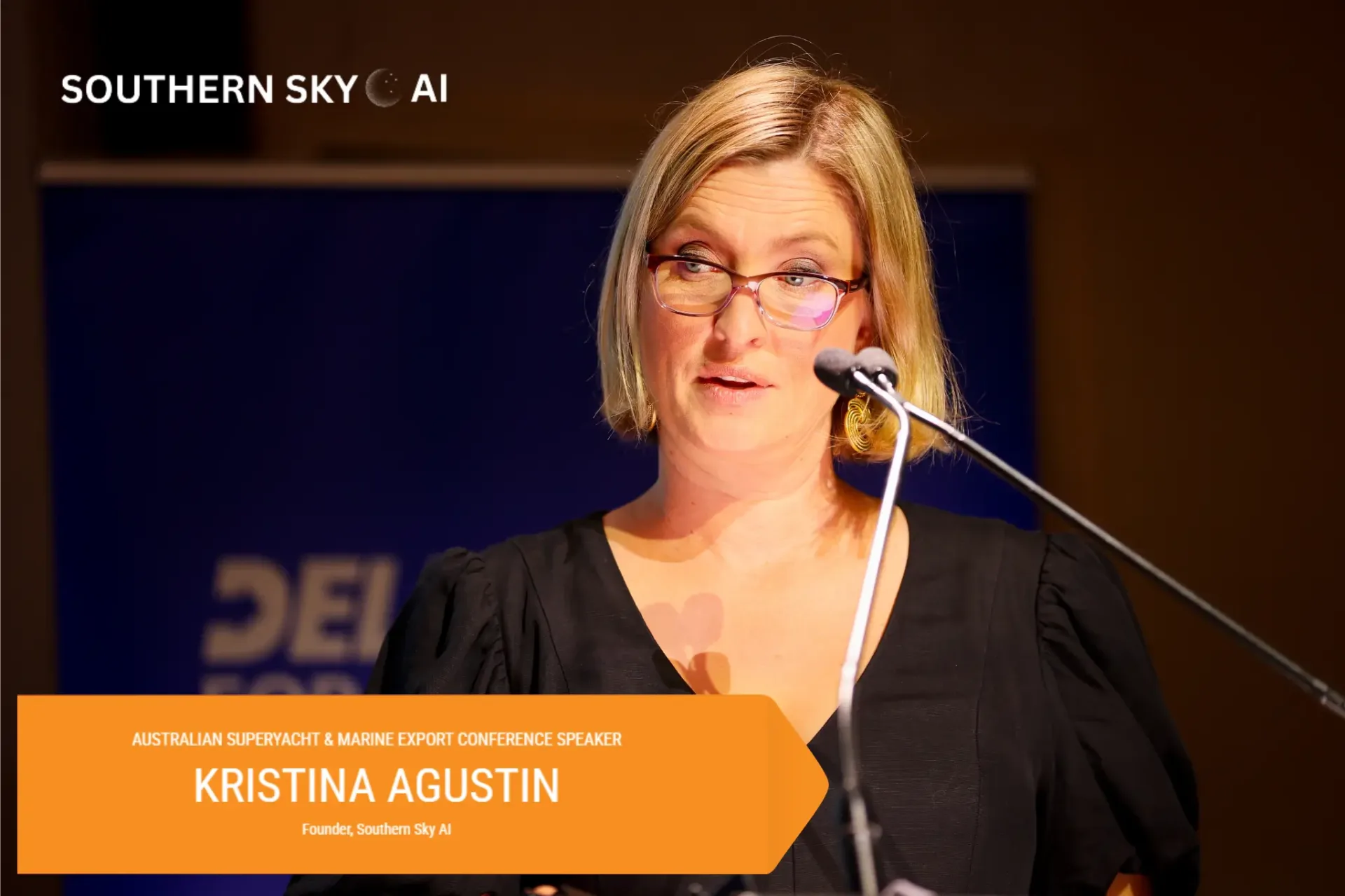
Kristina Agustin is the Founder of Southern Sky AI, a structured AI adoption practice for maritime leaders. She has 20 years of maritime operations experience, is an admitted Lawyer, and holds AWS Certified AI Practitioner and IWAI Certified AI Consultant credentials.