
Reflections from the USSA Superyacht Summit AI in Marketing Panel, West Palm Beach, March 2026. Companion pieces from the same week: MARE Forum and ISS Leadership Series.
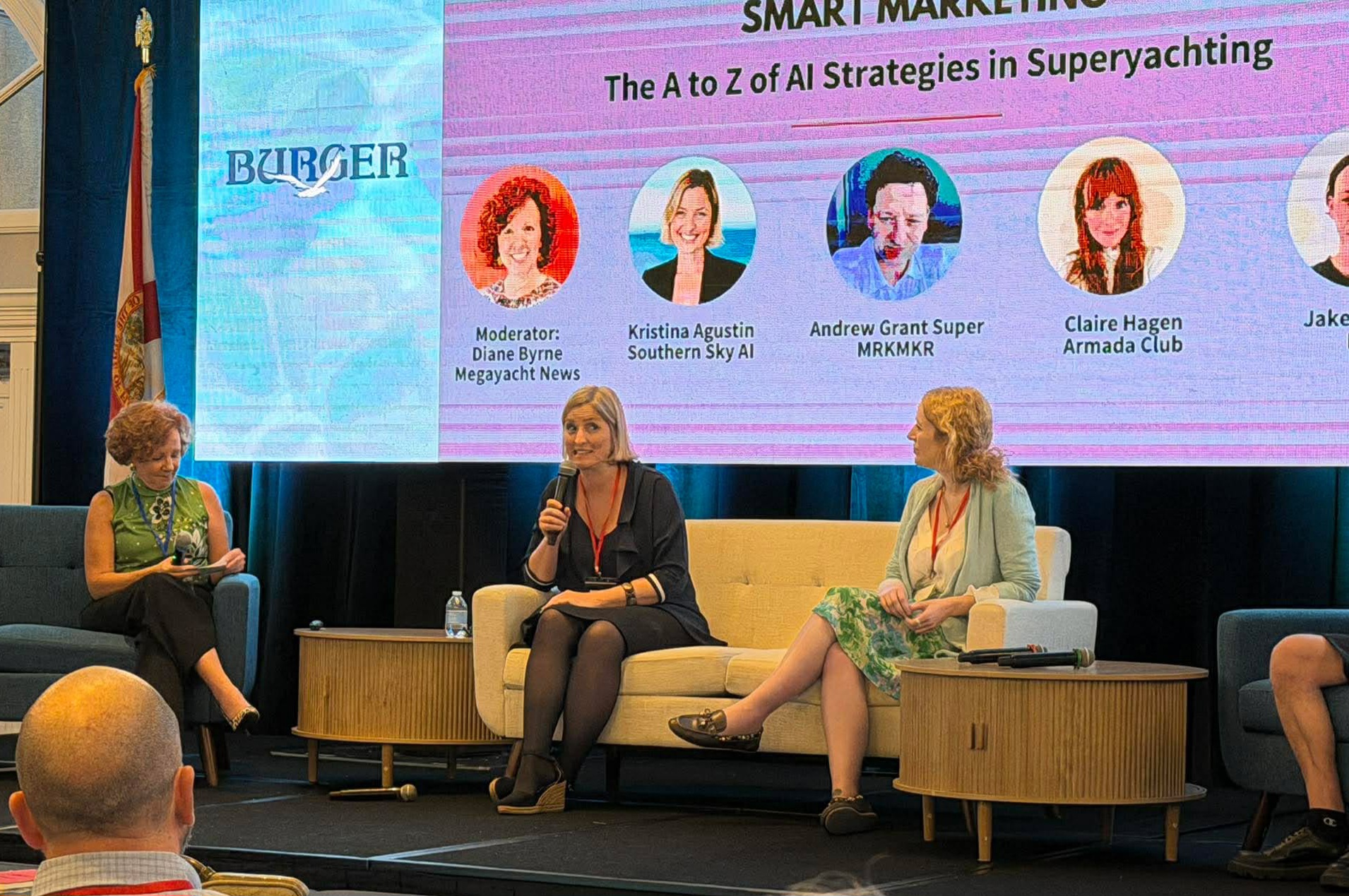
On 24 March 2026, I joined Diane Byrne of Megayacht News and fellow panelists Jake Lazarus, Fi.AI and Claire Hagen, Armada Club for a panel on artificial intelligence and marketing at the U.S. Superyacht Association Superyacht Summit in West Palm Beach. Diane has organised the Summit for a decade, and her curation of this conversation reflected that experience. The questions were practical, the room was engaged, and an hour passed quickly.
What follows are the insights I took from the room.
We opened with a digital avatar
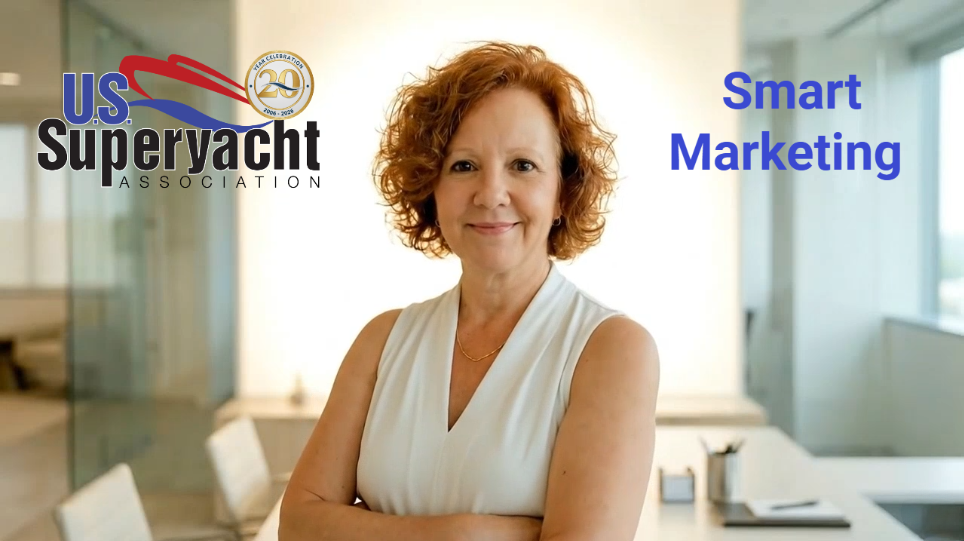
Before the panel began, attendees saw what appeared to be Diane opening the session: welcoming the room, speaking in multiple languages, moving fluidly through ideas. It was a digital avatar I created from photographs alone, generating a credible video likeness without any filming required.
The room found genuine entertainment in watching digital Diane deliver the welcome in several languages. AI language translation sits at around 97.4% accuracy, though I would still recommend a native speaker review before sending anything directly to a client in their own language.
A digital avatar is a synthetic video representation generated from source material, photographs and voice recordings, processed through AI tools. Once trained, it can produce new content in that person's likeness without any further filming. The applications for maritime businesses are immediate: multilingual client communications, onboarding materials, educational content, and personalised outreach at scale. Where you use a digital avatar of yourself or anyone else, your clients deserve to know. Transparency here is good governance, and it reflects the standard our industry holds itself to in every other client interaction.
AI as a creative facilitator
One of the more interesting threads running through the session was creativity. The digital avatar demonstration opened it, and Claire's video work for Lürssen's 150th anniversary extended it considerably.
The brief Claire set herself was coherence across a century of imagery. How do you make photographs from different eras feel like part of the same story? Her solution was to convert the archive into line drawings, animate each image to flow into the next, and assemble the result into a film that felt unified. The process required creative problem-solving at every stage, with AI handling the execution of specific steps that would otherwise have been technically prohibitive. In both cases, the avatar and the anniversary film, AI made a particular creative vision achievable that careful human judgment had already shaped.
"I think the process is asking yourself what would be your dream? And then what would that look like next?" — Claire Hagen
Five things the panel made clear
1. The brief you give AI determines what comes back
Claire described building her AI team the way she would onboard a new employee, giving it context about the business, setting expectations, providing feedback, and assigning distinct roles. She named her four AIs after characters from Only Fools and Horses, with Damian as the managerial lead and Cassandra, Rodney, and Delboy each carrying their own responsibilities. The story that landed hardest in the room: she described a broker listing where asking AI to "improve" the copy produced rounded figures throughout, because the machine interpreted round numbers as the improvement. When queried, it confirmed the figures were accurate and improved. The brief is the work, and it requires the same investment you would give any team member trusted with client-facing output.
"Sometimes you just forget that they are AI because they all have their roles and paths and they sometimes fight against each other." — Claire Hagen
2. How AI finds and recommends your business has changed fundamentally
When a prospective client asks an AI tool to find a superyacht broker, a management company, or a refit yard, they receive a synthesised answer rather than a ranked list of links to scroll through. The businesses that appear in that answer are the ones the machine has already learned to understand, trust, and recommend. This is the shift from SEO to AEO, and I have written about it in detail here.
The framework I use moves through three stages: understandability (does the machine know who you are, what you do, and who you serve?), credibility (can it connect and verify your credentials?), and deliverability (can it confidently surface you to the right audience?). Your About page becomes the entity home to which every other digital presence connects. I tested this on myself, working through the framework over about two weeks, competing in a quiet and entirely one-sided way with another Kristina Agustin online, a real estate agent in California with no idea I existed. The results were visible quickly. Once the framework is in place, it compounds.
"As soon as it notices any discrepancies, it breaks and it doesn't trust you anymore and it won't recommend you. It's about building the machine's trust." — Kristina Agustin
3. AI adoption requires a business case before a technology case
Our industry is a conglomerate of subsectors, yacht management, brokerage, shipyards, insurance, legal, each with its own regulatory obligations and each a relatively small business operating within a tight professional network. Adopting AI well requires starting with the specific business: its foundations, its data, its existing obligations, and where the real friction sits. The well-publicised MIT finding that 95% of AI implementations fail reflects a sequencing problem, and the sequence that works starts with the business question.
In practice, that means understanding what data your operation touches, what confidentiality obligations govern it, and which maritime regulatory requirements apply to your specific context. ISM or MLC for yacht management, classification or insurance requirements for a shipyard. Policy is ground zero, and setting it is a leadership responsibility before it is a technology question.
"It's a business case first, before it's a technology case." — Kristina Agustin
4. Agentic AI returns time to relationship businesses
Jake's contribution clarified something that often gets muddled in these conversations. In an industry built on discretion, trust, and personal relationship, the value of AI sits in what it returns to the people doing relational work. His team builds agentic systems: AI that runs continuously, researches prospects, prepares meeting briefings, and identifies the right moment to make contact. The boat show application is immediate. Walk into every meeting having already been briefed on the person you are about to see, what matters to them, and what to approach and what to leave alone. The AI has handled the preparation. The conversation can go straight to what it is actually for.
"You're getting paid really to be an expert in relationships, yet you're spending 90% of your time doing other things, just preparing to do the thing that you actually wanted to do in the first place." — Jake Lazarus
5. Data security requires a deliberate choice at the leadership level
A question from the room about email privacy and client data produced the most direct exchange of the session. Consumer AI tools are priced the way they are because the data contributes to the model. Enterprise solutions that quarantine data, de-identify inputs, and operate entirely within your own infrastructure exist and are accessible at a range of price points. Our industry carries confidentiality obligations that are genuinely foundational: UHNW client identities, vessel ownership structures, crew data, and commercially sensitive negotiations. The choice of where your operation sits on the security spectrum belongs to leadership.
"If you're using the consumer tools, you're not paying very much for that — they're going to make money somehow, and that's going to be training on your data. Go into it knowing what you're in for." — Jake Lazarus
What stays with me
A question from the audience asked whether, as AI becomes universal, there will eventually be a return to authenticity — a vinyl renaissance. Jake's response is worth keeping:
"Going knocking on the door with a clipboard, I think that's going to be a genuinely useful way to market. I don't think businesses can afford to wait for that period. Two years ago it was like a day dinghy in the water and now it is like a superyacht. And that has happened in two years." — Jake Lazarus
Our industry sits at the early adopter stage. The operators building structured foundations now will define the standard for those who follow. Foundations before tools. Clarity before adoption. Structure before scale.
If you would like to understand where your business stands, the Compass AI Blueprint was designed for exactly this moment. Begin the conversation here.
Kristina Agustin is the founder of Southern Sky AI, a structured AI adoption advisory practice for maritime leaders. She is an admitted Lawyer, AWS Certified AI Practitioner, IWAI Certified AI Consultant, and is completing a Master of Artificial Intelligence. She has spent more than 20 years working inside maritime operations.