
Reflections from "Inside the Modern Luxury Buyer", the third Yacht Femme Forum of 2026.
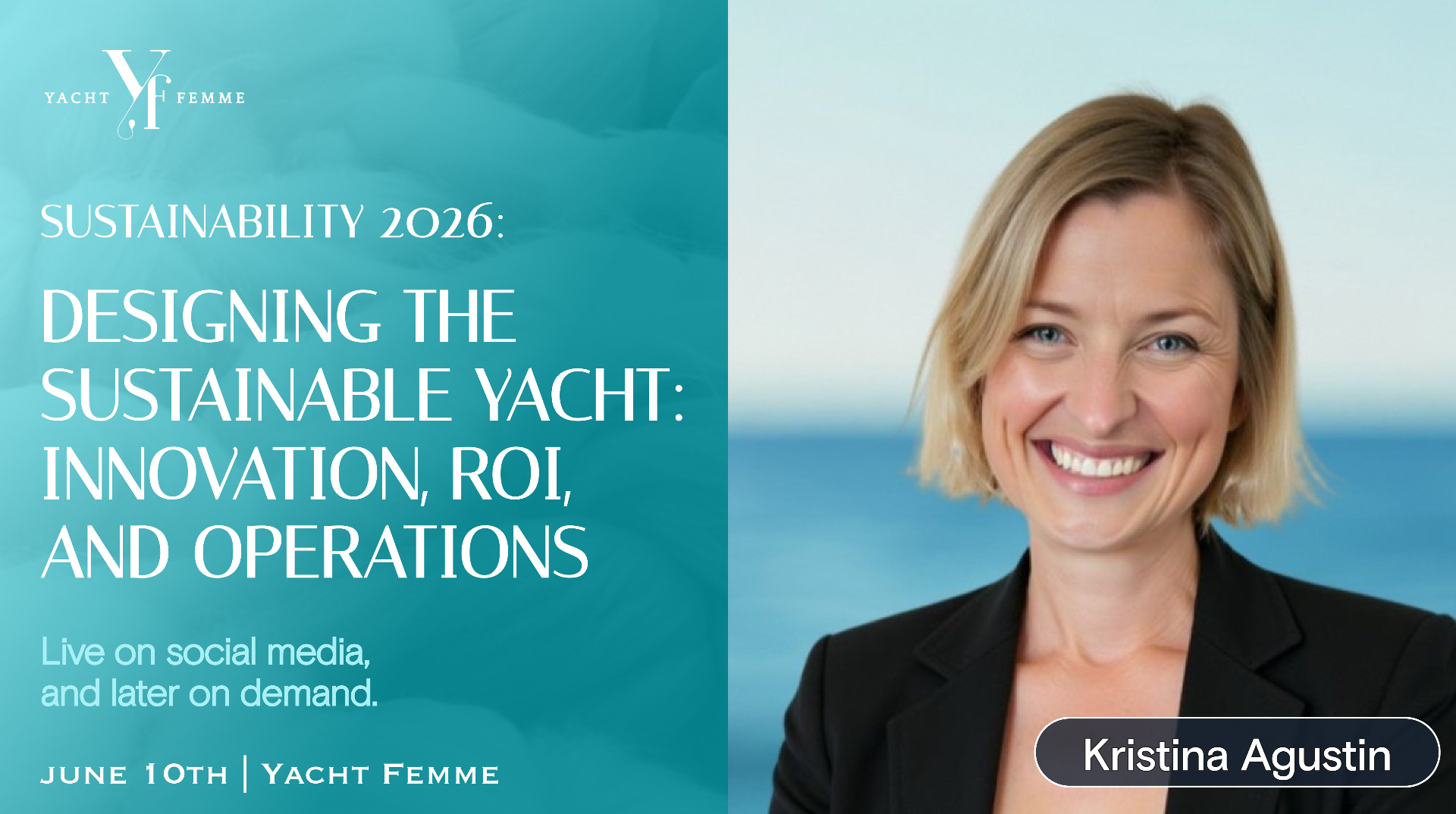
On 10 June 2026 I took part in the third Yacht Femme Forum of 2026, "Inside the Modern Luxury Buyer", broadcast across Yacht Femme's channels. The forum brought together voices from yachting, aviation, and the wider luxury sector to look at how the modern luxury buyer is changing, and how brands meet that change while upholding the discretion and trust the industry is built on. My segment, "Data That Builds Trust", focused on data-driven personalisation. I shared it with Adra Graves of Make Analytics Work, a data and customer insights leader with two decades in marketing technology, moderated by Sophie Spicknell, News Editor at SuperYacht Times. What follows are the insights I took from the room.
Panel: Data That Builds Trust, Personalisation in the Luxury Market. Panellists: Kristina Agustin (Southern Sky AI) and Adra Graves (Make Analytics Work). Moderator: Sophie Spicknell (SuperYacht Times). Watch on the Yacht Femme YouTube channel.
Large consumer businesses personalise at scale. They read patterns across millions of people and make confident generalisations, because the crowd is big enough that any one person disappears inside it. Luxury maritime works at a different scale entirely. The community is small, the relationships are long, and personalisation happens at the level of one person. That single difference shapes everything that follows: how data is handled, what privacy means in practice, and why careful data practice reads as service rather than friction.
Four words that often blur into one
Much of the confusion around data begins with four words we tend to use interchangeably. Separating them makes the rest of the conversation simpler.
Privacy is a legal concept. It covers any information that can identify a person, on its own or combined with other data, and it carries clear obligations: collect only what you need, use it only for the purpose you named when you collected it, keep it only as long as that purpose requires, and protect it across its whole life. At its heart, privacy is a person's right to control what is known about them and how it is used.
Confidentiality is a relational concept. It is the trust between two parties: if I share this with you, you will keep it safe.
Security is the practical layer. It is where information is kept and how it is protected.
Discretion is the professional instinct that sits over all three. In yachting, when we say privacy, we very often mean discretion: the judgment to carry what we know lightly and use it well.
Privacy is a person's right to control what's known about them and how it's used. It's a legal protection.
— Kristina Agustin
Adra grounded the security layer in a concern many leaders now share. As teams reach for AI tools, confidential material can end up pasted into a chatbot in the form of a question. She described business leaders moving to set clearer standards, after seeing that a junior analyst could upload an entire company P&L into an AI system and start asking questions of it. Her emphasis fell on building a culture that is deliberate about what gets shared, and where.
There have to be standards set around that, and a culture around being thoughtful about what gets shared where.
— Adra Graves
The tools themselves can be configured for this. For anyone working through which AI system fits a confidentiality-heavy operation, and how to set it up safely, I cover it in Why Maritime Professionals Are Moving to Claude. The wider question of which problems are right for AI in the first place is taken up in Which Problems Belong to AI.
Personalisation here starts with the individual
In a large dataset, individuals dissolve into the aggregate. That is what makes broad personalisation safe at scale, and it is how the biggest companies use AI: as a pattern-recognition engine working across enormous volumes.
Our industry has different numbers. The pool of people is small, and two or three data points are often enough to identify exactly who someone is. Aggregation that truly removes re-identification becomes very hard to achieve. So personalisation here is built another way: on knowing the individual well, within the bounds of what you are permitted to keep and the reasons you keep it.
The pool of people is small. With two or three data points, it's easy to pinpoint exactly who someone is.
— Kristina Agustin
AI gives you replicas of answers
This is also where human judgment earns its place. Adra made the point that the answers an AI tool returns are best understood as replicas of answers. They show you what an answer might look like, and they need to be checked against what you already know.
They aren't answers per se. They're replicas of answers. They're what answers might look like.
— Adra Graves
Adra used the example of a 3D printer. You could print a bicycle. It would look like a bicycle and might even work like one. If you needed to ride it fifty miles, it would not be your first choice. AI outputs sit in the same place. They are directions to consider, shaped by whatever context the system happens to have, and the person in the room almost always carries more context than the machine. You might remember that a particular client wore a Valentino blazer last season, and that one detail changes how you read everything the system suggests. Feeding that kind of knowledge into a model is difficult. Recognising when it matters is human work. This is the same point that runs through the ISS Leadership Series panel on AI in yachting: capability is not a mandate, and the considered judgment about what should remain human belongs to the people in the room.
Transparency is now law
Disclosure has moved from good manners to legal obligation. Where you use a client's data, you are required to be clear about what you are using, how you are using it, and why.
From 2 August 2026, the European Union's AI Act brings in transparency obligations under Article 50. People have to be told when they are interacting with an AI system, and AI-generated content has to be identifiable as machine-produced. The Act reaches well beyond Europe. It applies to the organisations that build AI systems and to those who deploy them, and its obligations follow EU-based clients, crew, and counterparties wherever the business itself sits. An operator in the United States or Australia handling European clients is inside its scope.
A question came through from LinkedIn during the session, from Caroline Dobbs-Thompson, asking whether Article 50 would apply across the whole industry. The short answer is yes. The EU AI Act was the world's first AI law, it is already in force, and it is being rolled out in stages, with the August transparency obligations among the next to take effect. I keep the regulatory timeline current in the Southern Sky AI governance reports for anyone who wants the detail, including the ISO/IEC 42001 management standard for maritime that is becoming the reference for how this work is structured.
Discretion as the service advantage

A stewardess setting down a coffee on a yacht deck at night, with faint constellation lines drifting near the cup
Reframed as discretion, careful data practice becomes part of the service itself. It is the same instinct that defines the highest level of hospitality.
Early in my career I spent several years as a chief stewardess. The finest service I saw anticipated a guest's needs before they thought to ask. You gathered that understanding by paying attention: who had been up late, whose patience was thinning, who liked their coffee at a particular hour and their meal at another. You carried that knowledge and used it for one purpose, to look after the person in front of you. Collected with care and used for the reason it was gathered, data does exactly the same work.
The highest-end service was the one that anticipated needs before the person thought to ask.
— Kristina Agustin
Adra added a useful way to think about the data itself. Third-party data is demographic information you can buy. First-party data is what you need to run the business, a name and an address. Zero-party data is what clients tell you directly about how they want to be treated, the preferences that let you offer the right experience to the right person. The thoughtful use of that last category is what makes an interaction feel made for someone.
Everyone wants to feel seen, and this is table stakes for the luxury experience.
— Adra Graves
What will define personalisation next
Looking ahead, the strongest personalisation in luxury maritime will come from depth rather than breadth. AI is a pattern-recognition machine, and in our industry the patterns that matter belong to individuals rather than to large segments. The work is reading one person's patterns closely, using only the data you are permitted to keep and for the reasons you keep it, and stopping well short of surveillance.
These systems can surface inferences a person might never see in themselves. My own AI tools have shown me patterns about myself that gave me pause. The system has no knowledge of who I am. It finds a shape in the information that I had not noticed. Used with discipline, that capability deepens a relationship and protects the trust the whole industry runs on.
It's going to be about knowing that particular person, only based on the data you're allowed to have and for the reasons you have it.
— Kristina Agustin
Adra pointed to how the largest platforms now invite businesses to hand over the creative and let the AI determine targeting, testing replicas of answers in the world and reading the early signals for what is working. At consumer scale, that approach is reshaping how personalisation operates. In luxury maritime, the same instinct appears at the level of the single relationship: form a hypothesis about what a particular client values, then watch for the quiet signals that confirm it.
Trust is the throughline
The thread running through the whole conversation was trust. In a small industry built on long relationships, data earns its place only when it makes the relationship better, and it makes the relationship better only when it is handled with discretion: clear purpose, careful collection, honest disclosure, and human judgment over the output. That is structured adoption applied to the most sensitive information a luxury business keeps, which is what it knows about its clients.
If you would like to understand how your own data practice stands up, and where AI fits within it, the Compass AI Blueprint was built for exactly this kind of question. Begin the conversation here. Senior leaders working through this at the individual level can take the same questions into a For Executives engagement, and teams who want to build the underlying skills can start with the Academy.
My thanks to Sophie Spicknell for moderating, to Adra Graves for a generous exchange, and to Yacht Femme for hosting the forum.
Kristina Agustin is the founder of Southern Sky AI, a structured AI adoption advisory practice for maritime leaders. She is an admitted lawyer, an AI governance professional, and is completing a Master of Artificial Intelligence. She has spent more than 20 years working inside maritime operations. southernsky.ai