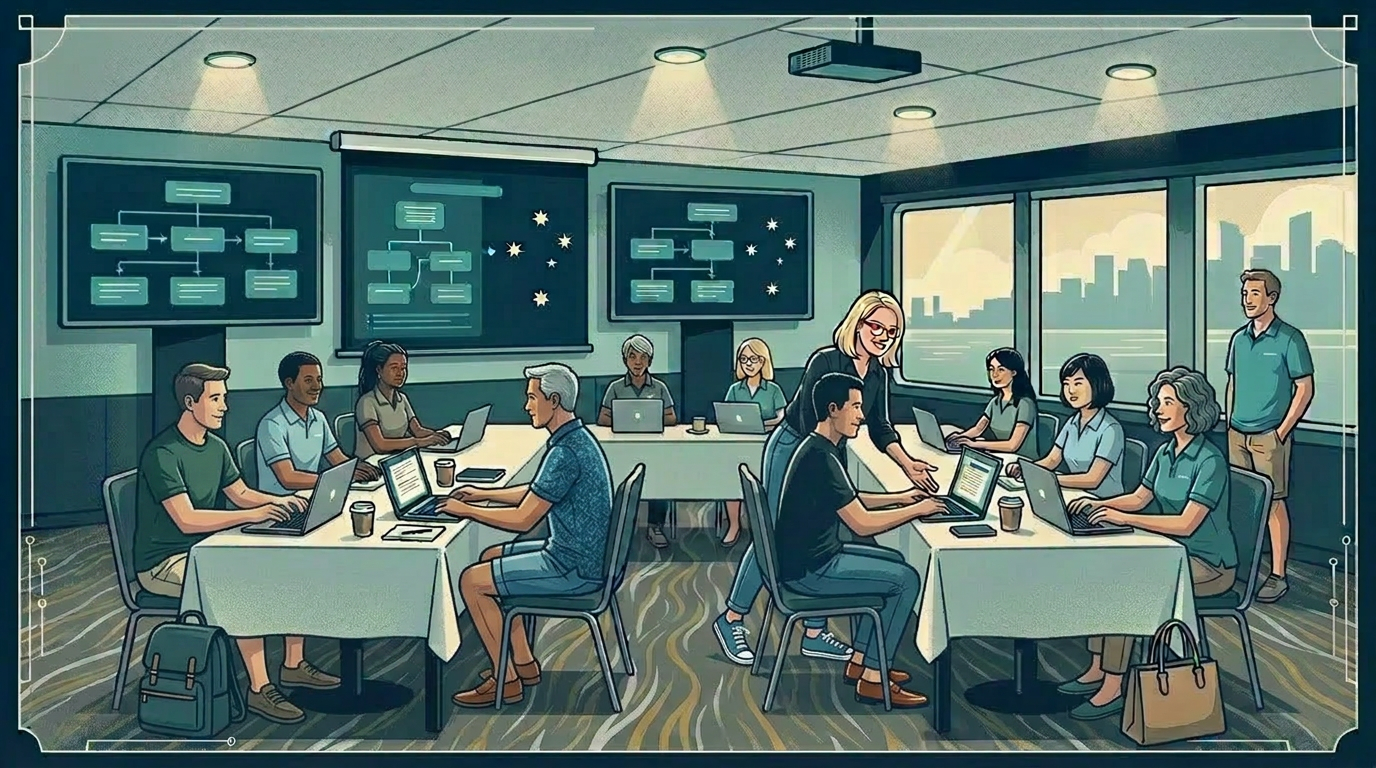

A senior leader at a regulated marine insurance firm starts the monthly reporting cycle from a saved AI workflow that runs sixteen insurer reports end to end. A team of five at an owner-led maritime organisation finished one training day with a working automation built from a live finance task, a governed platform to run it on, and a board-ready AI Use Policy. And eighteen people across ten departments of a harbour cruise operator are using AI more often and sharing what's working, on one shared standard for what good use looks like.
That's what training is for: capability people keep, confidence on real tasks, and a clear sight of what's possible in their own role. AI has arrived faster than working habits can absorb, so the practical job of a training day is unsticking people: showing the applications, building the first working piece at each person's own desk, and leaving the team moving.
Those are three training engagements from the Log Book on this site, and set side by side they answer the two questions I hear most about training: what does the day cover, and what does my team keep afterwards?
A whole shoreside team: eighteen people, ten departments
The harbour cruise operator had sanctioned AI platforms in place and a spread of experience across the team, from confident daily users to people meeting the tools properly for the first time, and no shared standard yet for what good use looked like. That spread is normal. AI arrives person by person, and each person builds their own way of working with it.
We started with an audit across twelve departments, then designed three role-based workshop days from what it found. Each day ran the same four stages: orient, personalise, codify, practice. A data protection rule came before anyone touched a platform, and one quality method carried through everything: CHART, which stands for chart the task, hand over clearly, assess the output, refine through the turn, and track and govern. It gives eighteen people in ten different jobs one shared answer to what good use looks like.
Each person in the room left with a configured workspace, a shared prompt library, and at least one reusable Skill built from their own role tasks. A Skill is a saved AI workflow you can run again without rebuilding it, so the win from the training day keeps paying out on ordinary Tuesdays. The client has since reported the team is using AI more often and sharing what's working: eighteen people in ten different jobs, spanning maintenance, marine, finance and executive functions.
One executive first: the marine insurance engagement
A regulated marine insurance business, holding its own financial services licence, came at it from a different angle. Capable staff had already found uses for public AI tools on personal accounts, covering tasks their core platforms couldn't reach, and the business moved to give that initiative a governed home: a platform with a commercial data agreement behind it, and one executive capable on it first.
So the format was a one-day, one-on-one foundation session, built from that executive's existing AI context. We set up the governed team plan, applied data classification rules to the categories of information the business handles, then ran a real piece of the job end to end: the monthly management accounting workflow, sixteen insurer reports, through the CHART method. That workflow now starts from a saved skill each month. The session closed with a take-home toolkit, an explainer video, and two policy documents scoped: an AI Use Policy and a privacy policy revision, traceable to the Privacy Act 1988 and its recent amendments.
The production AI tools the business already ran stayed unchanged. This is AI capability built one executive at a time, and for a regulated firm with a small team, that phasing is the point: one person becomes capable on a governed platform, and the rollout grows from there.
A whole organisation in one day
The third engagement was a small, owner-led maritime organisation: a handful of people carrying a wide workload, with client correspondence, financial information and operational documents moving through every working day. The chief executive wanted governance in early: a documented position the board could adopt, a data rule the team could apply themselves, and a clear answer to which platform holds the organisation's account and why.
The day ran foundations before configuration: how the models work, where the risks sit, how to monitor use. Then hands on. Five people came away with configured workspaces on one governed team platform, each with a personal context file, plus three live connectors into the systems the organisation runs on: file storage, the accounting system, and the email marketing platform. The first working skill was built from a live task in the room, the chief executive's quarterly finance report, drawing directly from the accounting system.
The governance came out of the same day. A data classification framework was applied to the organisation's real content, and an AI Use Policy was drafted and refined on the spot, grounded in the Australian Government's Guidance for AI Adoption and the Privacy Act 1988. What a written position like that goes on to do for a business is a subject of its own; when someone asks for your AI position in writing follows four organisations through it. The rhythm afterwards is simple: a weekly team agenda item where returns from AI get shared, and quarterly reporting to the board on AI governance. The chief executive can already see measurable time savings.
What a training day covers
Across all three, the shape holds. Before the day, we review the tools and policies you already have. On the day, everything is role-based and runs on live tasks from your operation, on the platforms your organisation sanctions: a data rule first, foundations next, then building at each person's desk with their own material. Afterwards you keep the materials, with the patterns and guardrails documented so they can be taught to the next person who joins. And there's a sequenced pathway for what training comes after, if you want it.
It's for the whole range of the team. The harbour cruise cohort spanned maintenance, marine, finance and executive functions; the insurance engagement was a single senior leader; the small organisation put its full team of five through together. Crew to executives, the format bends to the room.
Attendees come away certified as well, each certificate carrying a unique ID printed on the document and linked from the recipient's profile, checkable by anyone at southernsky.ai/verify. If a client, an insurer or a board ever asks what your team's training amounts to, there's a public answer to hand them.
Signs the standard hasn't been set yet
If AI is already in use around your operation, a short structural check:
- -Tasks run on personal accounts, and the organisation doesn't hold the account they run on.
- -More than one subscription covers the same job, and there's no written answer to which platform is the organisation's and why.
- -Results vary by desk, because each person has developed their own approach separately.
- -There's no named step where a person reviews an output before it reaches a client.
- -Useful prompts stay with whoever found them, because there's no shared place to keep them.
None of those are about ability. Every one is a missing piece of structure, and structure is what a training engagement adds: the habits and instincts your team has already built carry straight in, and they get a shared standard to run on.
Where to start
The training page sets out three formats. A Training Day, USD $1,700: one day, live, in person or online, foundations on the tools your organisation sanctions. A Capability Day, USD $2,500: deeper and department-specific, building working patterns from your live tasks. And the AI Champions Programme, by agreement: multiple sessions building internal capability, with materials your champions use to teach the rest of the organisation. There are also self-serve modules and refreshers to keep capability current as the tools change.
If you'd rather read your position before booking anything, start with the AI Baseline on this site; it links from the training page. The full detail on all three formats is at southernsky.ai/ai-training, and I'd like to hear where your team is starting from.