The twelve questions an AI use policy has to answer
July 17, 2026
What an insurer, auditor or client reads for in an AI use policy: twelve questions that test any draft, template-started or written from scratch, before someone asks to see it.
Industries · Superyacht Interior
The season runs on the other side of the world, and this coast is where Australian crew train, take rotation leave and come ashore. What AI already does for the interior, what stays out of a public tool, and a certificate that can be checked from anywhere.
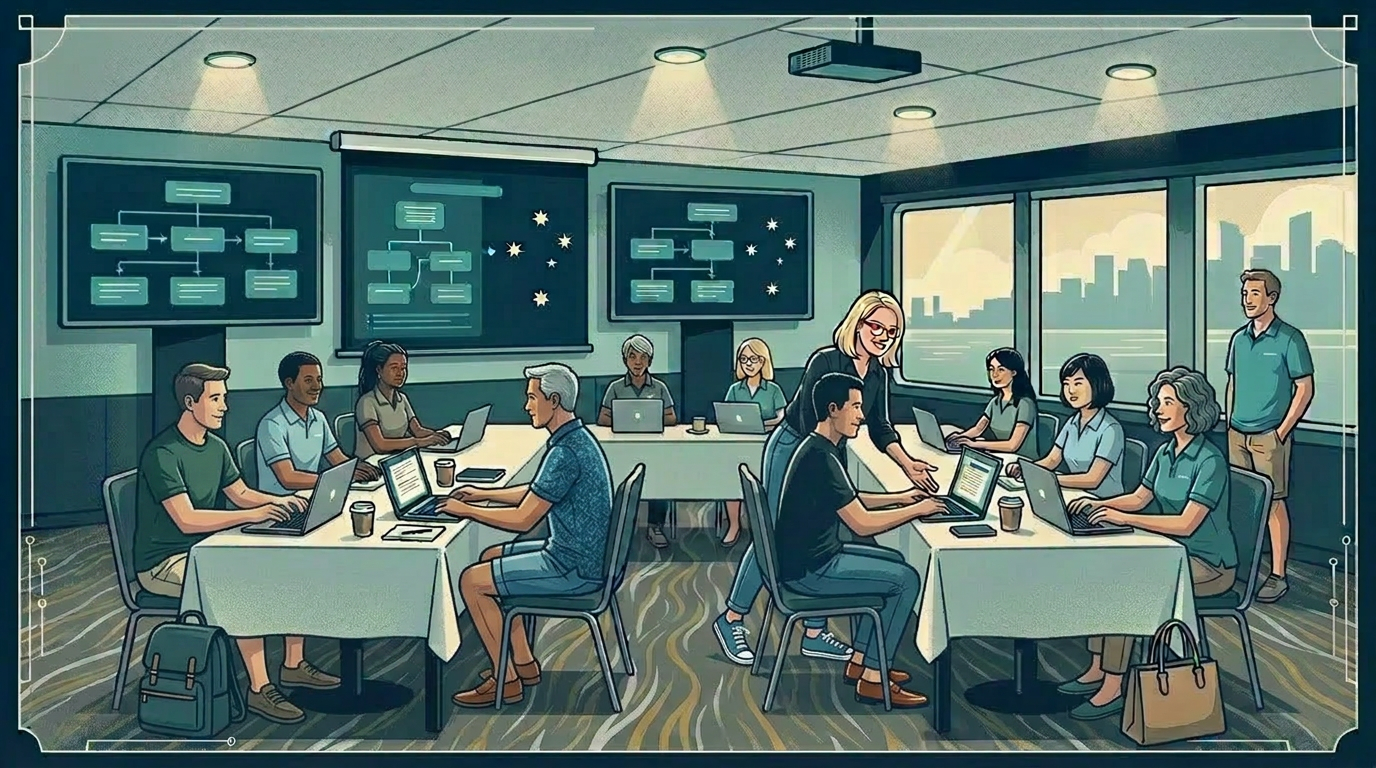
It is 11pm on a turnaround, the laundry is still running, and tomorrow's guests land at ten. Somewhere in the next two hours the inventories get updated, the preference sheet gets briefed to a second stew who joined last week, and the provisioning order goes in. This is the part of the interior nobody photographs.
AI tools can carry part of that load, and your team has probably started using them already: menus, guest letters, SOPs, translations. The gap is quieter than the workload. The preference sheet holds allergies, medical notes and the family's name, your NDA covers those lines, and the crew have had no brief on what can go into a public tool and what stays out. I spent twenty years in interiors before I worked in AI governance. The line exists, and it can be taught in a day.

Where are you based?
Where this sits for you
Superyacht Australia forecast the industry at 4.35 billion dollars and more than 33,000 marine jobs by 2025, concentrated in Queensland, and Brisbane 2032 projections run to 1.8 billion dollars in business output from the anticipated vessel influx. The shoreside roles an interior career leads to are part of that growth.
Australians are consistently named among the most prevalent crew nationalities in the world fleet, many trained in Sydney or Cairns before working the Med and Caribbean circuit, and the move ashore at home is a documented career arc. A certificate that can be verified from anywhere serves both ends of it.
Junior crew turnover averages 37 percent a year, and replacing a single stewardess costs €10,000 to €20,000. The chief stew carries that number twice: she absorbs the workload of the gap, and she re-trains the replacement while the season keeps running. The higher the tips, the shorter juniors tend to stay.
Stews and chefs report the lowest mood ratings of any department aboard, and 64 percent of female crew say their mental health declined after joining the industry. The season's pace falls hardest on the department that never gets photographed. This page will claim no product fixes that; it belongs on the record because it is true.
Inventories, provisioning, budgets, preference sheets, SOPs, uniform stock and training records, most of it still in spreadsheets and email even where Voly-class systems exist. This is the load AI drafting most obviously relieves, which is why your juniors have already started using it, on personal accounts, without a line to stay inside.
After the top interior role, the sea offers nothing higher, and the shoreside CV question waits: employers ashore struggle to read "silver service and discretion". Portable, certifiable skills are the direct answer, and AI capability with a verifiable certificate now sits among them.
The preference sheet you own lists allergies, medical notes and the family's name; your NDA covers all of it, and breach commonly means immediate termination plus damages. AI reached the interior team before anyone briefed them on where the line sits between drafting help and disclosure.
The Opportunity
Many Australian interior crew train to a structured framework before the first season: Superyacht Crew Academy in Sydney and Crew Pacific in Cairns are documented entry points to the circuit, so a short structured course with a verifiable certificate is a familiar format on this coast. No provider's catalogue lists a crew AI course as of July 2026, in Australia or anywhere else checked. The course is delivered from its home market, with individual seats running year-round and timed for rotation leave and the season's shoulders, and the certificate is verifiable at southernsky.ai/verify wherever the next interview happens, Palma, Fort Lauderdale or back home.
Menus and provisioning
A seven-day menu the galley once built in ChatGPT in under five minutes gets drafted from a headcount and a brief, with a person stripping any allergy or medical detail that identifies a guest before it goes near a public tool.
Guest letters and itineraries
Welcome letters and day itineraries get drafted for the guest folder, with the chief stew reviewing them and keeping the family's name and movements off any public model.
SOPs and service cards
Standing procedures and service cards get written up quickly for a second stew who joined last week, with the chief stew checking them against the boat's own standard before they are briefed.
Inventories and stock
Inventory and uniform stock lists get tidied and formatted in a fraction of the turnaround time, with the interior lead confirming the counts before the order goes in.
Preference-sheet briefings
The brief a second stew needs from the preference sheet gets drafted in plain terms, with the sensitive lines, allergies, medical notes and the family's name, held back from any public tool and kept for the crew to handle directly.
Handover and training notes
Turnover checklists and training quizzes for green crew mid-season get drafted for review, with the chief stew approving them before they reach the team.
These are the workflows the confidentiality-safe prompt library and the training day stand up, under the standard the crew-mess card and the policy set.
Your World
The overnight turnaround
On a turnaround the cabins get detailed, the laundry runs late and the provisioning order goes in before the next guests land, often past 11pm.
The preference sheet
The preference sheet holds allergies, medical notes and the family's name, which makes it the most sensitive document the interior owns.
APA reconciliation and summaries
On purser boats the job adds APA reconciliation, end-of-charter financial summaries and crew travel to the interior admin.
Detailing the interior
Detailing the cabins, the deep cleans and the maintenance windows fill the off-charter days behind the service guests see.
The Med and Caribbean season
The season runs the Med from May to September and the Caribbean from December to April, with charter boats working back-to-back trips and new guests arriving week to week.
Green crew mid-season
The chief stew re-trains green replacements in the middle of the season, since junior crew turnover keeps arriving and resets the training with the turnover.
The GUEST modules
The IAMI GUEST programme is the interior's career framework, and senior crew self-fund four-figure credentials up to the purser units, so a certificate reads as professional development.
The charter tip split
Charter tips run 10 to 15 percent of the fee in the Med and 15 to 20 percent for US charters, split across the crew.
The 37 percent turnover
Junior crew turnover averages 37 percent a year, and replacing one stewardess costs 10,000 to 20,000 euros.
The crew-mess groups
Community happens in closed Facebook groups like Palma Yacht Crew and Antibes Yacht Crew, where jobs and advice circulate between boats.
Rotation leave as study time
A growing share of senior interior crew now hold rotation, which gives predictable time ashore in shoulder season for a course.
The line travels with the crew
Whether the boat is working the Med or the Caribbean, the crew are drafting on personal accounts over crew Wi-Fi, and the line about what stays out of a public tool travels with them.
GDPR and the prefs sheet
EUIn Europe the preference sheet holds allergies and medical notes on a high-net-worth family, which GDPR treats as special-category data, and the NDA in your employment agreement covers the same lines.
Privacy regulator published AI framework
HKOn 11 June 2024 Hong Kong's Privacy Commissioner published "Artificial Intelligence: Model Personal Data Protection Framework", the first AI-focused personal data protection framework in the Asia-Pacific.
Privacy penalties reach the millions
SGSingapore's PDPA binds organisations handling personal data there, with financial penalties up to S$1 million or 10% of annual Singapore turnover, whichever is higher.
Season runs November to April
APACSoutheast Asia's high season runs November to April, the mirror of the Med, with shorter and more spontaneous charters through the Hong Kong, Singapore and Thailand hubs.
Fort Lauderdale is the hiring dock
USFort Lauderdale is the hub of the US winter season, where boats staff up from October as the fleet crosses ahead of the winter itinerary and the boat show.
Prefs can be special-category data
EUA single dietary line on a preference sheet can reveal a health condition or a religious belief, and at that moment it is special-category data under GDPR Article 9.
Where to start
The vessel's written position and working start: the AI use policy, approved tools, a prompt library sized to the interior's admin, 90 days of team education, a recorded briefing for command, and a 30-minute walkthrough call with 30 days of email support. Purchased by the vessel: USD $690 founding, then USD $990.
Certificates verifiable at southernsky.ai/verify
Documented Work

3 role-based workshop days, designed from a 12-department audit · 18 people certified, from maintenance and marine to finance and the executive team · Every participant left with a working AI setup and a reusable Skill built on a real task from their own role · Weeks later, reported publicly by the client: the team using AI more, sharing wins, and a real shift in the day to day
A twelve-department audit produced three role-based workshop days that certified eighteen people across ten departments, with the CHART quality method and the data rule embedded across the team and every certificate carrying a public verification page.
Read full engagement
2,040 indexable pages · 1,645 articles migrated · 146 member and partner listings · Over 1 million requests a month · ChatGPT reading 9,400+ pages in a single day · Cited and fetched live in ChatGPT daily
The Asia-Pacific Superyacht Association (APSA) was running a static HTML website carrying close to fifteen years of content. Southern Sky AI rebuilt it as a platform of 2,040 indexable pages, 1,645 migrated articles, a 146-listing member and partner directory, and 47 events, with structured schema.org data on every page and an llms.txt file. The site now handles over a million requests a month, is cited as a source in ChatGPT, and is read live by AI assistants every day, and in one recent day, ChatGPT's crawler alone read more than 9,400 pages.
Read full engagementReading

June 2026
What the frameworks say, how far they reach, and what organisations can do now.

July 17, 2026
What an insurer, auditor or client reads for in an AI use policy: twelve questions that test any draft, template-started or written from scratch, before someone asks to see it.

July 11, 2026
Seven days with Anthropic's Fable 5 across client systems, two product launches, and back-burner builds. What one person can carry, and what stays human.

Written from inside your world
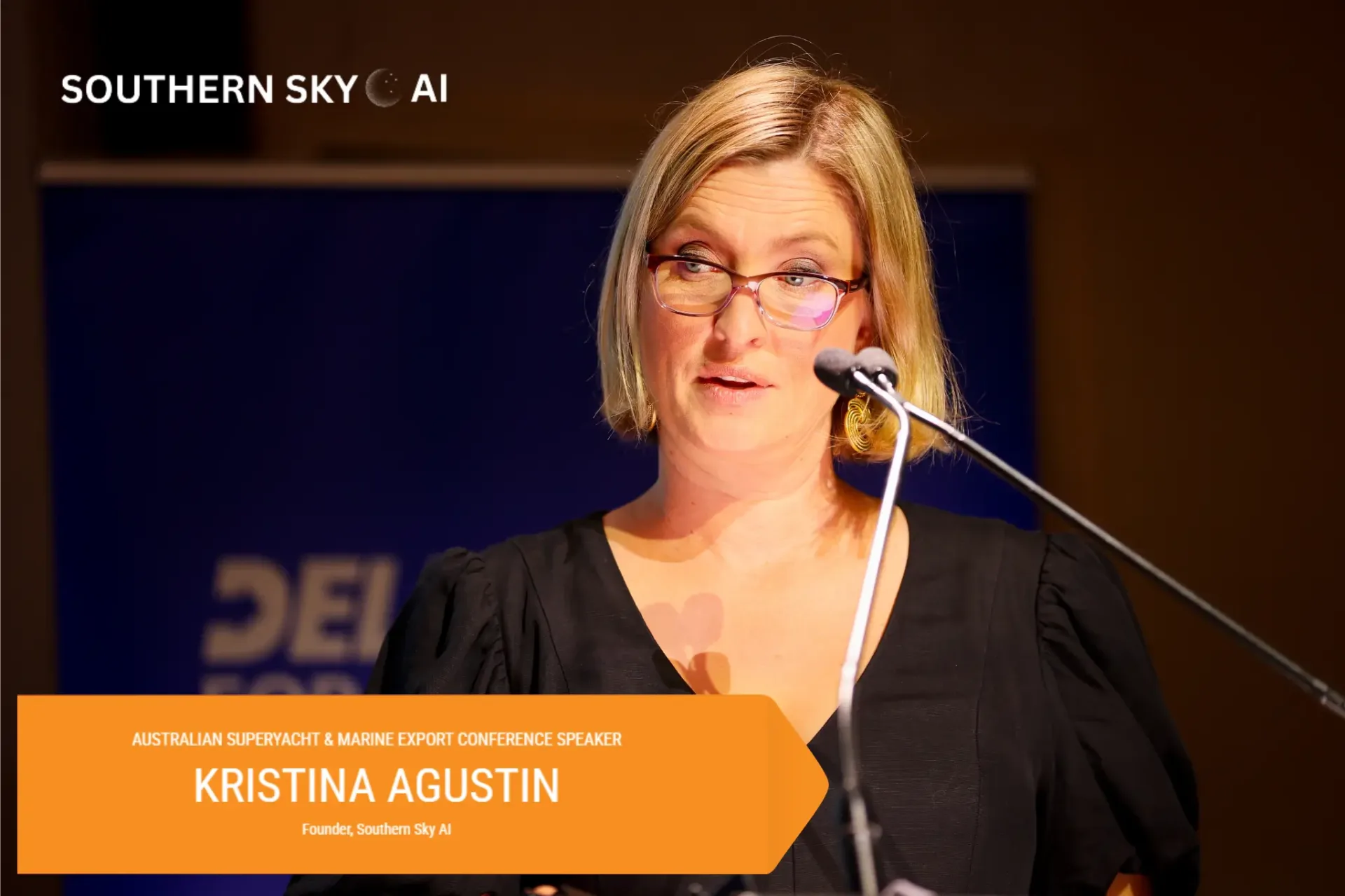
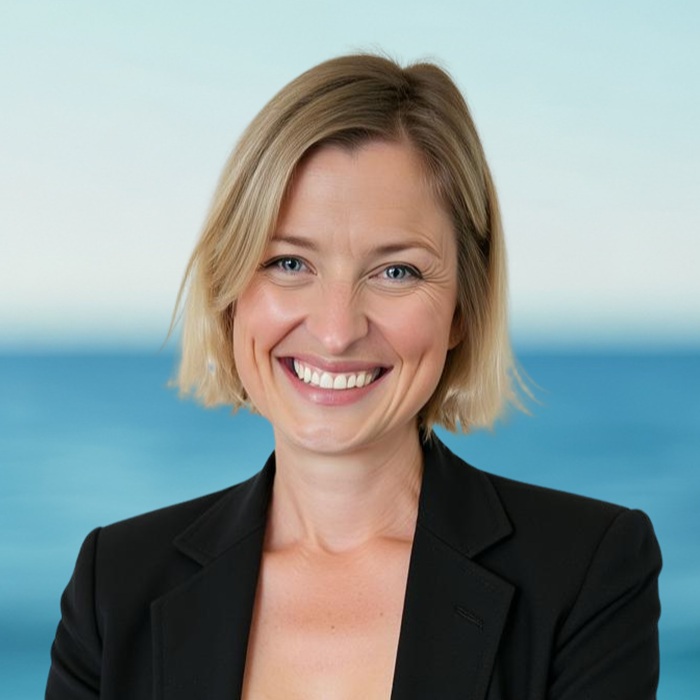
Kristina Agustin
Founder & Principal Digital Navigator, Southern Sky AI
20+ years in international superyacht and maritime operations. Legally trained (LLB, Graduate Diploma of Legal Practice). AI educator and consultant. ATSE Elevate Scholar 2026.
Start Here
Send your captain the Baseline. It reads the vessel's position on AI in about five minutes, in plain terms, before anything goes wrong.
Get your baselineQuestions
The AI Baseline Report reads your position in about five minutes, and your answers pre-fill everything that follows.
Run the Baseline