
AI for charter brokers and managers.
More time for the client. Less repeat work behind the enquiry.
An introductory conversation ↗Start with the work.
Make AI useful.
Three areas to explore in your AI Blueprint.
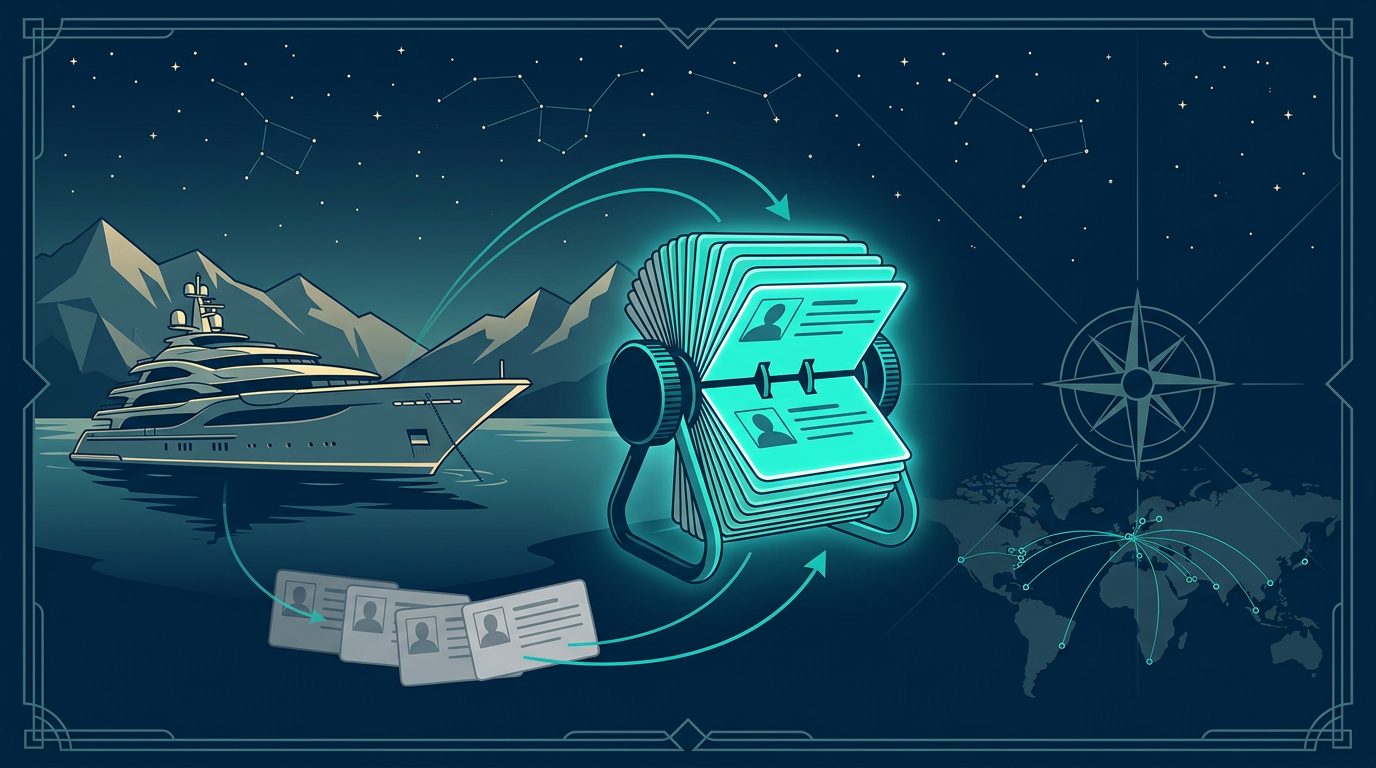
An AI roadmap for a charter business.
Seven opportunity areas, organised into a phased adoption plan.
Read the project ↗Your industry.
Your context.
Open the guidance relevant to your organisation.
Experience and approach
The record so far
221 obligations tracked across 25 jurisdictions
- Every founding document reviewed by the legally trained founder before delivery.
- Documents usually within two business days.
- Training certificates independently verifiable at southernsky.ai/verify.
Figures as published on southernsky.ai, reviewed September 2026.
Industry context
Charter brokerage runs on judgement, relationships and a handful of peak weeks a year. The pressures arriving now are different in kind: AI shipped inside the platforms the trade already uses, a projection in the industry's own market report that puts AI in most bookings by 2030, and data rules that classify the contents of a preference sheet as the most sensitive category there is. None of it waits for a decision from the office.
Four hours to a proposal, for a client who books jets in minutes
The traditional proposal build takes about four hours of broker time per presentation, on the numbers published by the trade's own software makers, and enquiries arrive at all hours across time zones. The first credible proposal often wins the client.
The platform you already use launched an AI assistant
Ankor, the Australian-founded charter technology company whose 7,132-yacht database is billed as the largest in the world, launched an AI-powered platform at the 2025 Monaco Yacht Show pitched as "an assistant that never sleeps". The AI arrived inside the tool the trade already works in, ahead of any practice decision about it.
Your own market report puts AI in most bookings by 2030
Fraser's Global Superyacht Review 2026 projects that by 2030 around 70 percent of charter bookings in the ultra-high-net-worth segment will involve AI-based systems, and describes the broker's role as evolving from intermediary into data interpreter. The judgement that matches a party to a yacht stays a human sale; the systems around it are changing now.
Figures as published on southernsky.ai, reviewed September 2026.
Tools and examples
AI reached this trade through its own platforms first, proposal tools, calendars and e-contracts, and through the public chatbots already open on the office's screens. The workflows below are where it returns time this season, each with the person who checks the output before it reaches a client, a central agent or the record.
AI assembles the candidate shortlist, itinerary skeleton and rate summary from the fleet databases, turning the four-hour build into a same-evening response, and the broker reviews yacht fit, availability truth and pricing before the proposal is sent.
Preference-sheet handling with data discipline.
Structured intake replaces the WhatsApp-and-email scatter, and AI summarises the party brief for the central agent and crew, returning the pre-charter coordination hours. The broker approves exactly what leaves the office, with medical detail and anything concerning children shared on a named-need basis only.
Post-charter and rebooking correspondence.
AI drafts the explanation of the APA, the advance provisioning allowance paid ahead of embarkation, alongside the feedback follow-up and next season's suggestions from the file, returning the hours the reconciliation questions absorb, and the broker signs each message before it goes.
Cruising-ground compliance briefs.
AI keeps the per-destination pack current, licensing, tax on the charter value and entry formalities, drawn from primary sources, and the principal verifies against the regulator's page before any of it is quoted to a client, because destination rules are exactly the kind of detail that changes between seasons.
Owner reporting for charter managers.
AI drafts the owner report on weeks booked, enquiry pipeline and rate positioning, cutting the month-end assembly to a review pass, and the charter manager reviews before the owner sees a number.
These are the workflows the prompt library and training stand up, under the standard the AI use policy, approved-tools register and named checkpoints set.
Related reading
AI Governance for the Superyacht Industry
June 2026
What the frameworks say, how far they reach, and what organisations can do now.
Read full engagement ↗An AI Agent Acts For You
September 5, 2026
What an AI agent is, why one is usually a team of them working to an org chart, what a marketing build looks like inside, and the parts of the job that stay with you.
Read full engagement ↗Draw a Banana: How AI Models Work
August 30, 2026
Why a language model reaches for the most ordinary answer, how computer vision does the same thing with pixels, and why bias comes out of that mechanism rather than being added on top.
Read full engagement ↗About Kristina
Founder, Southern Sky AI
20+ years in international superyacht and maritime operations. Admitted Lawyer (Supreme Court of NSW). ATSE Elevate Scholar 2026, completing a Master of Artificial Intelligence.
Figures as published on southernsky.ai, reviewed September 2026.