
There is a note on my desk in my own handwriting. It says: "I am the bottleneck."
I did not post last week. If you follow me on LinkedIn you may have noticed the silence, and the reason is that I have been in what I started calling my Fable frenzy: seven days of pushing a new class of AI to the limits of my own use cases, to see what it could do.
What Anthropic released
On 9 June, Anthropic released Claude Fable 5, the first model it has made generally available from a new tier it calls Mythos-class: a level of capability above Claude Opus, which until now was the top of the range. Fable 5 and its sibling, Claude Mythos 5, are the same underlying model. The difference is safeguards. Mythos 5, with those safeguards lifted, is available only to a small set of vetted partners doing defensive cybersecurity under a US government program, where models in this class have been uncovering vulnerabilities that sat unnoticed for years in software people use every day. Fable 5 carries classifier guardrails on cybersecurity, biology, and model extraction, which is what makes it safe to hand to the general public. Anthropic reports those guardrails touch fewer than five percent of sessions.
The release did not run smoothly. Three days in, researchers reported a technique that bypassed some of those safeguards, the US government applied export controls, and Anthropic suspended access for everyone rather than risk a violation. For most of June, the most capable model ever offered to the public was simply gone. On 1 July it came back, hardened. Anyone who has worked in security will recognise the pattern: locking things down does not hold on its own. You let it out, you try to break it, and you fix what breaks, because if you can break it, somebody else will.
On its return, Anthropic included Fable 5 inside paid subscriptions for a limited window before it moves to pay-per-use credits.
The setup
I had three Fable 5 subscriptions at the 20x tier running for seven days, switching accounts whenever one hit its usage ceiling. Access inside our subscriptions was due to run until the 9th, and Anthropic then extended it to the 12th, so some accounts had reset and others had not. One reset on its own, and then all three reset again. In practice that gave me at least three full cycles at 20x across the week.
The outlay was about AU$300 per account for the month, and against what came out of the week, the return on that investment is insane. Two of the three subscriptions are already scheduled to downgrade to Pro at the end of the month, because this was a window and I treated it as one.
The week around it was full on its own. It was the first week of the school holidays and I was solo parenting through it. I delivered a day of one-to-one, in-person executive training on Claude foundations, and I held several client meetings. I had less sleep than would be healthy on a weekly basis. At one point I realised I had put off a walk so long, because I was in the flow, that I ended up walking in the dark and the rain. When the window was extended past the 9th, part of me was disappointed: I had been waiting to be cut off, because that was my signal to sleep. It was a power push, and I would not run a month this way.
Big Daddy and the smart teacher
Opus 4. 8 is the smartest thing most of us have experienced, far more capable than the most intelligent brain on the planet, and for most tasks it remains the right tool. It just felt like a smart teacher once Big Daddy came into the room. You are talking to the smart teacher, you are doing really well, everything is going great. Then Big Daddy comes in and blasts it all out of the water.
Fable 5 worked faster, it drew deeper connections across a project, and it seemed to have more capacity to understand the consequences of a decision and to think beyond the task sitting in front of it. When I asked for a fix, it would flag what the fix would break.
And I felt it most when it went away. Each time my limits ran out and I dropped back to the teacher, the difference was tangible. It was still excellent, but it was no longer quite drawing all the connections. I would find myself asking, "Did you look in this folder?" and Opus 4.8 would come back with "Oh, I did not think about that, good call." And I would think: Big Daddy knew this. I need to get him back. Then the limits would reset, the operation would lift again, and I would catch myself saying it out loud at my desk: "Big Daddy is back in the room."
To be clear, I am not saying Fable 5 was required for any of what follows. Now that the foundations are in place, most of it runs on much lighter models, and part of the week was proving exactly that. Fable 5 let me move a lot quicker and faster, and it made the hardest parts better.
I am the bottleneck
The operation was running at such a pace that it needed my approvals on certain things, and I could not keep up with what it needed feedback from me on. Often in working life you are the bottleneck, but you are working at another human's pace, so the constraint hides inside the natural flow of how fast anyone can go. This week it was obvious. The technology has bolted. The most advanced intelligence available in the world right now is available to people at home in their pyjamas, and the thing that stayed slow, the thing that set the ceiling on the week, was me: my judgment, my approvals, my decisions about what mattered and what could wait, my sleep.
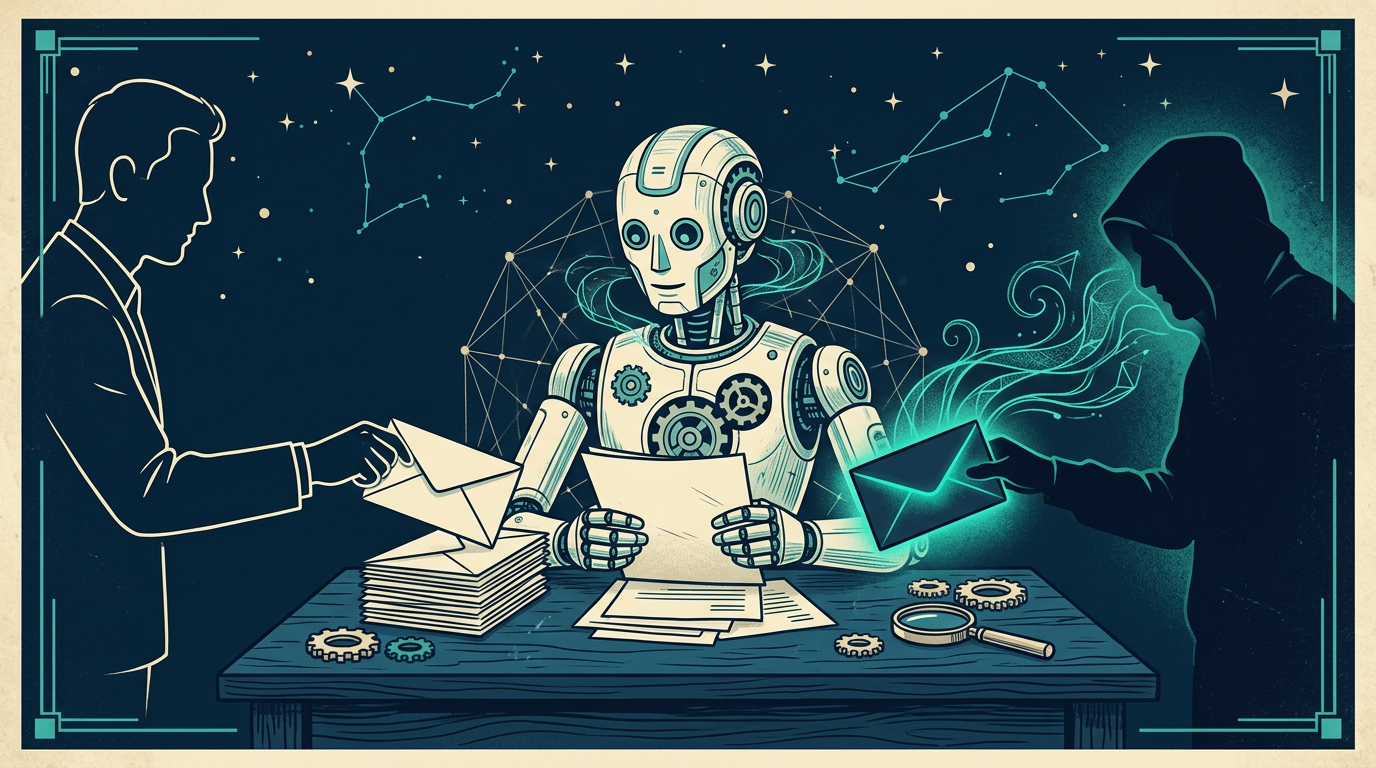
The decision points that held everything up were the ones a human should hold: what goes live, what spends money, what reaches a client, what carries my name. The job now is being the orchestrator, and designing those decision points deliberately instead of tripping over them at midnight.
The week's case studies
Everything here happened between 4 and 11 July. Some of it is client work. Some of it is Southern Sky AI. And some of it is personal projects I have had on the back burner for years, because they were never my priority, more of a creative outlet, and this was the week they were brought to reality. Together they show what one person can do, supercharged with a powerful AI.
Southern Sky AI: two products to market
The AI Baseline Report went live on my site. It reads a maritime organisation's AI position across security, privacy, operational, and business risk, maps the regulations that already apply, and returns a ranked set of priority moves, in about five minutes of the reader's time.
- -27 regulatory regimes in the engine, every one verified against primary sources
- -An adaptive question path of up to 19 questions across 6 chapters, adjusting to vessel operators, shore businesses, and organisations yet to touch AI
- -Wired end to end into my CRM, so a completed assessment delivers its report with no human in the loop
- -Its own explainer video, rendered the same week
Governance Essentials, the paid tier above it, went from a local prototype to nearly ready in a single overnight sprint. It generates a maritime AI use policy and its companion documents through an adaptive interview, with every clause traceable to its source instrument.
- -221 obligations mapped across 25 jurisdictions and 218 legal instruments, with 145 policy template blocks and 30 regulatory watchpoints
- -A 34-question adaptive interview, dropping to 19 when a Baseline run pre-fills it
- -Pressure-tested against 13 realistic operator personas, fixed, and re-run until all 13 passed
- -Checkout built and a founding cohort offer in place, with every founding output reviewed personally by me before it reaches the client
Both products are my methodology, built into a system. They draw on eighteen months of research, regulatory reading, and face-to-face conversations across the industry, and Fable 5 helped me turn that into the online version. It did not create it. The know-how came first, and the AI gave it a delivery mechanism.
Around those two products, the same week produced:
- -5 branded explainer videos of 60 to 90 seconds each, rendered on my own machine: an EU AI Act maritime explainer, the four kinds of AI risk, a prompt-injection explainer, the Baseline itself, and an early-adopter piece
- -A four-week content calendar with 14 drafted posts
- -A rebuilt five-area client portal demo, with 19 old routes redirected
- -Full executive training modules on Claude, ChatGPT, and the Microsoft enterprise stack, verified against a 36-source currency register
- -And the least glamorous job of the week, a huge endeavour in its own right: my business filing system cleaned up and reorganised into a single numbered operating doctrine, 13 core documents and a decisions log recording what superseded what and when. Organising my files turned out to be organising my thoughts. Every project now writes its own work log, handover notes, and memory, and that is the part I would keep if I had to give the rest back.
Client work: real deployment on real systems
For a superyacht charter business, a catalogue of roughly 2,360 charter yachts moved to the edge of go-live. This is a build I had used Claude to analyse, rewire, and get running after the original integration stalled: banks of vessel data becoming thousands of new pages on the site.
- -The last data-mapping gaps closed: specifications, galleries, rates, cruising areas, and video for every vessel, fed from an industry API
- -About 140 broken duplicate pages retired, and about 600 failed records re-queued after a server crash
- -Template fixes deployed to staging, from gallery layouts down to 51 yacht names whose apostrophes had been rendering wrong
- -A full go-live runbook written for pushing about 97,000 images and 28 gigabytes of media to production at a proven-safe 18 yachts per hour, a pace the hosting can survive
For an international industry association, this week was the payoff. The engagement has been rebuilding their website and membership operations into AI-assisted processes over months, and I used Fable 5 to draw the analytics and analysis on what we had been doing, reading the raw server logs directly.
- -The site now serves about 1.1 million requests a month, with 1,000 to 1,700 human visitors a day, across 1,645 published articles, 2,615 images, 77 pages, and 146 member directory listings
- -AI crawlers account for roughly 25 to 45 percent of all traffic. One AI search crawler read 9,403 pages of the site in a single day, live fetches from ChatGPT users run at 160 to 250 a day, and the first referral visitors have arrived from chatgpt.com
- -On the day the member email goes out, human traffic lifts 63 percent
- -The membership pipeline became real this week: a working automation now takes an approved application and creates the member's directory listing end to end, verified with a real applicant. Until this week, every one of their 147 listings had been made by hand
- -Two security improvements made on the live site, six process emails rebuilt, and 1,627 CRM contacts reconciled against the directory
The machines are already reading the industry's websites, at scale, and they are starting to send visitors back.
On both engagements, I have developers I refer to and work with, and they wired a lot of the initial work on these projects. The projects changed underneath them, and a good portion needed complete reworking. That is the normal condition of real systems, and it is the terrain where this technology now lets one accountable person carry what used to need a team on standby.
The back-burner projects, brought to reality
Two personal projects came off the back burner and became operating businesses this week. They exist as a creative outlet and a proving ground. The creative side of them, inventing characters, illustrating a cast, directing videos, was some of the most fun I have had with this technology.
The first is a seasonal e-commerce brand selling patterned print-on-demand sweatshirts. Last year I had virtual assistants helping me get it going for Christmas. It took weeks and weeks and thousands and thousands of dollars, and we did not even sell anything. A week ago it was an outdated site with broken product images and revenue leaking through untagged affiliate links. Seven days later:
- -A cast of 21 on-brand illustrated characters, each quality-checked as a patterned print-on-demand sweatshirt design with its own story article: a silly goose, a chill capybara, and a night owl among them. Each design ships as four print-resolution panels plus label, mockups, and manifest
- -10 traditional knit patterns composed by a purpose-built pattern engine, and 32 city designs for the US market: 63 product designs in total
- -Photographic on-model mockups, male and female models, front, back, and side, and a fully redesigned store
- -Roughly 72 articles written, fact-checked, and scheduled through mid-December, plus 42 social posts queued, with the affiliate links across 22 older posts repaired and earning
- -3 character teaser films and a 20-second launch video rendered on my own machine, with a production plan for a short film for each of the 21 characters
As I write this, exactly one product of the new line is live and purchasable. The upload pipeline for the rest hit a technical wall, the fix is designed, and it is the first job of the next session.
The second is a content platform serving a US audience, and a week ago it did not exist as a build at all. The first planning document was written on the Monday and the site was live on the Tuesday. Seven days later:
- -A live, indexed website with around 35 articles scheduled through to next January, on a 16-document operating foundation
- -243 social posts queued across five platforms, with coverage into late January
- -10 brand video shorts, an automated weekly newsletter, and a designed brand with an illustrated cast
- -Five autonomous scheduled agents that run the publishing operation while I am elsewhere
The research under it went deep. Every article started from keyword research validated against live search results, current trends, and fresh policy, including a brand-new tax change that lifted a childcare credit and gave the content an edge no older article on the internet has. Fourteen of the articles were written by fourteen parallel writer agents, each passing a scripted quality gate before publication. Eighteen affiliate programs were researched and fourteen shortlisted and ranked, with an application runbook. Every factual claim was checked against primary sources, tax office publications and fee schedules included, and then a five-agent audit re-verified about 180 of those claims across the whole site and corrected 26 errors, one of them a health-insurance enrolment date that could have cost a reader a year of coverage.
The subscriber count today is zero. The publishing machine is built, the audience building starts now, and I have given it six months to prove itself, in writing.
And the modules are ready for uni
In the gaps, my university preparation for the new trimester happened in one overnight session:
- -An 85-file study system for my next unit
- -Every lecture and tutorial transcript harvested and organised, 42 in all
- -Every deadline tracked in one place
- -A standing study-assistant brief that knows how I learn
The system exists so that a person with very little time never misses a deadline.
The system, not the chatbot
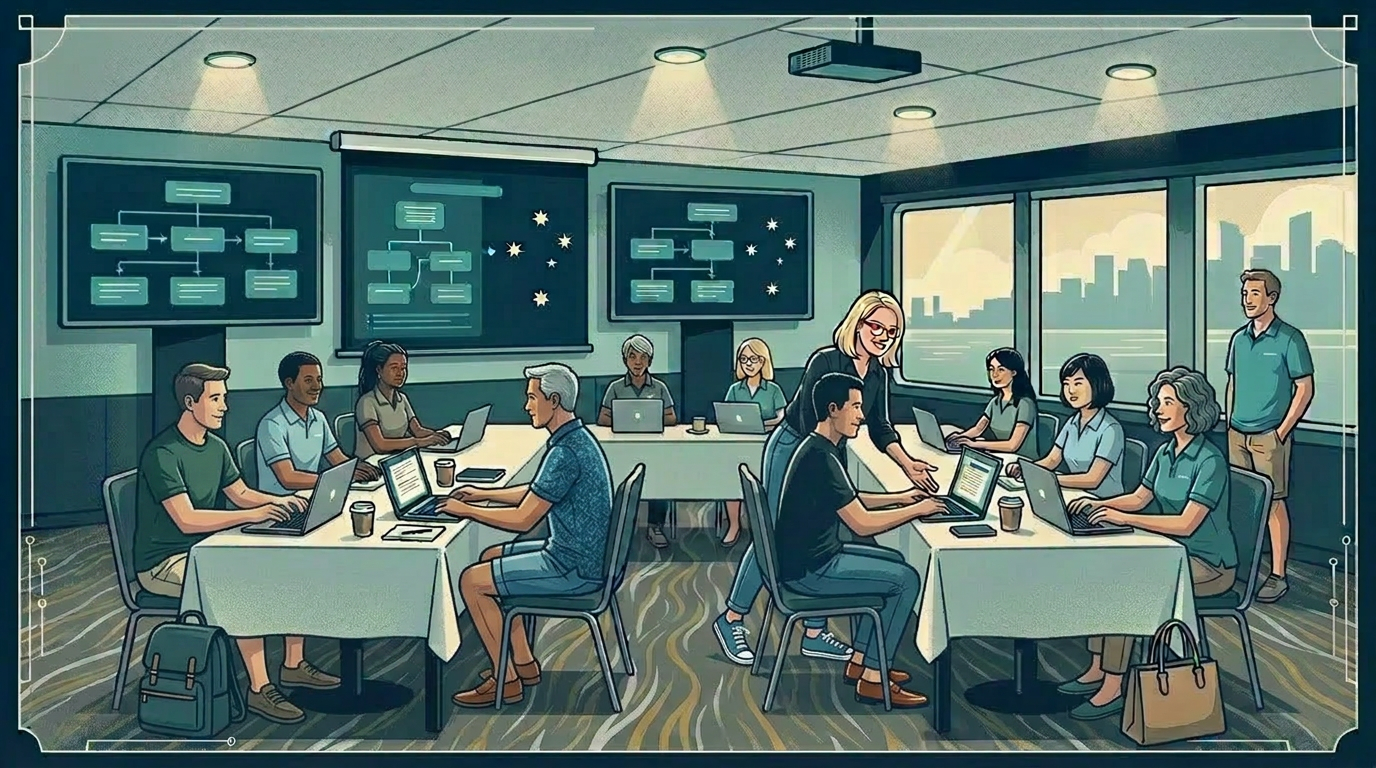
None of this happened inside a chat window. The reason this is so powerful is that it is Fable 5 connected to things: the model reaching into the back of the programs I already run, using them, and bringing me back a document.

One console at the center, threads to many connected systems
Across the week, that one console was wired into WordPress and WooCommerce, Google Analytics and raw server logs, my CRM, Stripe, Supabase, Airtable, the Make and n8n automation platforms, HyperFrames by HeyGen for video, the Gemini API for visual and audio creative, industry platform APIs like Yachtfolio and Printful, and my own Google Drive. I stopped counting the connectors somewhere past fifteen.
The handoffs are the point. A yacht record flows from an industry database through an automation platform into WordPress, and I read the result as a staged web page. An approved membership application flows through the CRM into a directory listing, and I read it as a draft awaiting one click. A video script becomes narration, becomes an animated render on my own machine, becomes a scheduled post. My filing system in Drive is the shared memory between all of it: one project alone wrote 41 numbered handover documents so that any session, on any account, could pick up where the last one stopped. I sit at the console, the tools work, and what comes back to me is a decision to make.
Learning the split
I do get a strong feeling that this initial push is about getting people hooked on the drug of profound intelligence: an included-access window, and once you are cut off, you just want more. A colleague in the industry messaged me mid-frenzy to compare notes. They had run out on their plan, kept going on credits, and burned through about £80 in an hour.
This top-shelf intelligence is going to stay available, and once the come-in special is over it goes behind an API gate: pay-per-use, at roughly US$10 per million tokens in and US$50 per million tokens out. It will be just as available, but it will be pay-per-use and you will need a top-shelf reason to use it. The marketing funnel on this will be very effective, and it will also cause a lot of people to cry when they look at their bills.
The lesson coming for all of us is to prioritise: decide what needs top intelligence and what runs perfectly well without it. For me, this week was about learning that split. Build the foundations with the best mind available, then hand the running of them to lighter, cheaper models. The foundations I built with Fable 5 now operate every day without it.
One console
I believe we are going to be running our businesses from one console, whether that is Claude, another provider, or a specialty maritime platform built for our industry. The jumping in and out of ten different systems to get information, the copying and pasting between them, is on its way out. Chatting with AI will be maybe five to ten percent of what you do, and that will be the planning phase. The rest will be execution.
And we will not always be doing it from a desk. There is a lot of foundation work and planning between here and there, but once everything is wired up correctly, the governance is in place, the parameters are set, and the education is done, the console lives on your computer and the mouthpiece of it comes with you on your phone. A lot of the heavy, deep work this week I did from my phone, directing the computer sitting at my desk at home.

Phone in hand, teal signal arcing to the desk at home under a starry window
One conviction I hold firmly alongside that: the record of the business should live outside any single AI. Stay platform agnostic. Filing systems remain as important as ever, because that is where the brain of the business lives, the context, outside the AI itself. That is why the least glamorous job of my week, the filing cleanup, may prove the most important one: any console, from any provider, can pick up that context and run.
Governance is the launch system
If the bottleneck is the human decision points, then AI governance is the discipline of designing those decision points on purpose. Governance done well is a secure system built so you can launch forward: who approves what, before which step, documented, so that when the machine runs at full pace you can let it, because the checkpoints hold. It is a risk management system, much like the safety management system you already run, and it now applies to spend as surely as it applies to risk. Deciding where top-shelf intelligence is warranted is a governance decision with a monthly invoice attached.
Plugging this class of AI into a business that has no starting point automates chaos. But once you have a comfortable starting point and training, once everyone is working from the same base and the decision points are designed, you can deploy AI to such a degree that it is almost unfathomable what you can achieve. Before this week I could reason about the possibilities. Now I have felt them.
Even with Fable 5, one person cannot do everything. I draw on developer expertise from within my AI networks when a project needs additional bandwidth or specialist depth, and that will continue. What this week did is shift my perspective to a completely different place about what is possible, and about what is already in the hands of people at home in their pyjamas.
Where this leaves things
I ran this experiment on my own business first, the same way I would want anything tested before it reaches a client. The result is on the record: two products to market, two client systems moved to the edge of go-live, two dormant ventures now operating, a training curriculum, a filing system that finally deserves the name, and my modules ready for uni.
All of it in seven days, while carrying my own life: solo parenting through the school holidays, a full day of one-to-one executive training, client meetings, a lot of balancing, and a lot less sleep than usual. I would not recommend the sleep part. But this is what one person can achieve. Imagine what your whole business could achieve. It is almost unfathomable.
If you are weighing what this class of AI could carry in your own operation, and where your decision points should sit, that is the conversation my practice exists for. Start with the Baseline and read your position in about five minutes, or reply and tell me what you would attempt with a week like this. I would like to hear it.
As for me: next week is the second week of the school holidays, and I am taking the kids away. One laptop only, some sunshine, and some sleep. Until next Sunday.
Kristina Agustin is the Founder and Principal Digital Navigator of Southern Sky AI, helping maritime and professional organisations adopt AI with capability and good governance.