
AI for passenger vessel operators.
Connect the office, the booking journey and the people on board.
An introductory conversation ↗Start with the work.
Make AI useful.
Three areas to explore in your AI Blueprint.
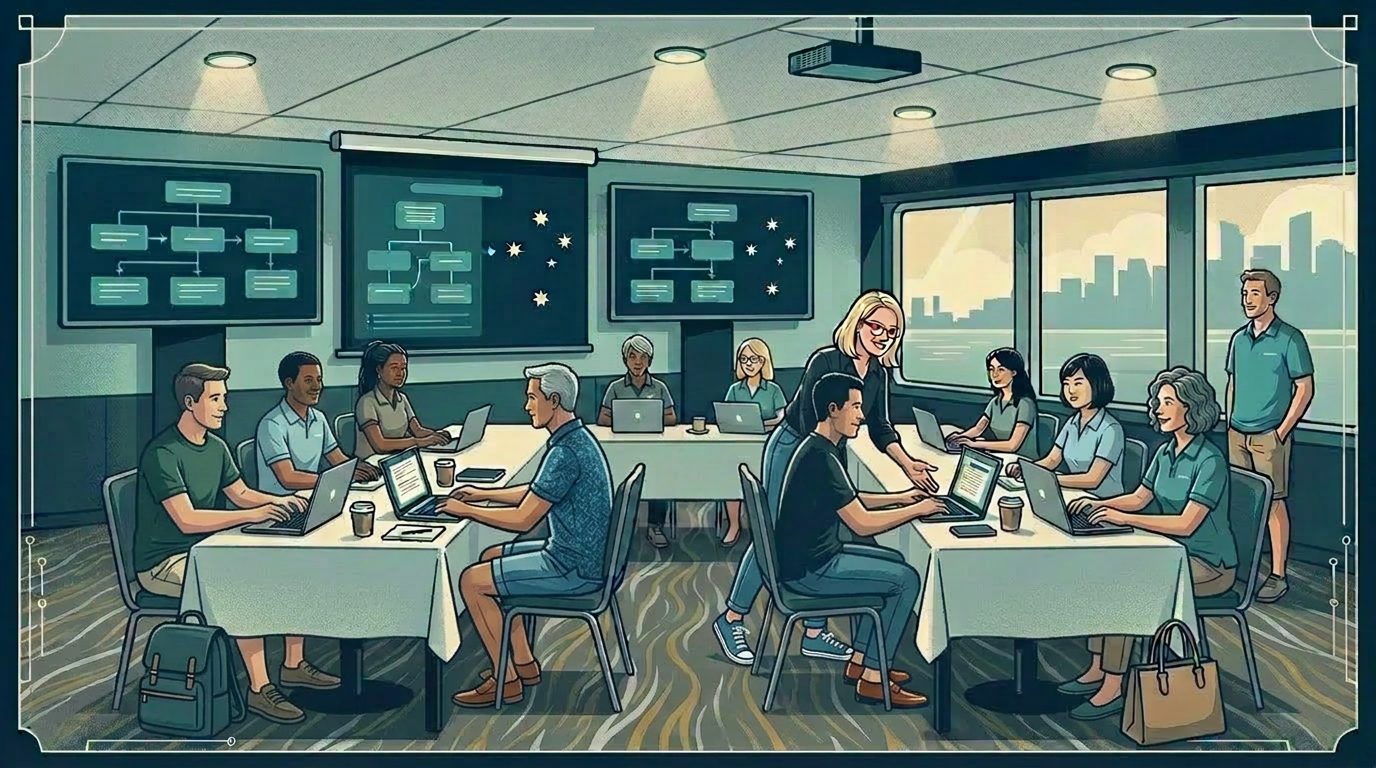
Practical AI training across ten departments.
Three workshop days for 18 participants, using tasks from their day-to-day work.
Read the project ↗Your industry.
Your context.
Open the guidance relevant to your organisation.
Regional context
Ten operators run twenty-one licensed ferry services across Hong Kong's harbour and islands, and Singapore's port already runs on a digital twin. What AI is already doing across operations like yours, and the safest way to start.
Prefer to talk it through first? Book an introductory conversation.
Experience and approach
The record so far
221 obligations tracked across 25 jurisdictions
- Every founding document reviewed by the legally trained founder before delivery.
- Documents usually within two business days.
- Training certificates independently verifiable at southernsky.ai/verify.
Figures as published on southernsky.ai, reviewed September 2026.
Regional context
of tourism operators reporting AI already in use across parts of the business.
OTA commission on every booking before processing and cancellation costs.
Industry context
Those same uses form a pattern without an owner: guest records moving through tools that were never procured, safety-adjacent documents drafted by systems that have never stood on your deck, and a brand that carries the story if one of them gets it wrong. You already run the discipline this needs. Your safety management system names who checks what before the vessel leaves the berth, and AI governance applies the same discipline to a new hazard class, so the productivity your teams found stays and the practice becomes reviewable.
Two No. 10 signals in one season
2025 brought two Hurricane Signal No. 10 typhoons to Hong Kong, Wipha in July and Ragasa in September, with storm surge up to two metres above normal and 661 vessels affected or at risk across Hong Kong and South China ports, and every suspension and resumption was a passenger-communication event with a record behind it.
The 2030 harbour craft clock
From 2030 every new harbour craft in the Port of Singapore must be fully electric, able to run fully on biofuel, or compatible with net-zero fuels, and design consultation with MPA becomes compulsory from 2027, so AI arrives on a desk already running the biggest change programme in the fleet's history.
The adoption push and the governance frame
The Singapore Tourism Board, Singapore's tourism agency, funds generative AI adoption across tourism businesses through its AI Playbook and Tcube centre, while IMDA, Singapore's infocomm and media regulator, publishes the Model AI Governance Framework and the PDPA, Singapore's privacy law, carries penalties reaching S$1 million or ten percent of turnover. The written position that joins the two is still yours to build.
The fare file stays yours
Key outlying routes have run on government helping measures since 2011 and the Vessel Subsidy Scheme has helped operators buy new ferries since 2019, while operators say the schemes cover pier and vessel costs rather than wages or fuel, so the fare file, the incident file and the correspondence with the Marine Department stay the operator's own work.
Figures as published on southernsky.ai, reviewed September 2026.
Tools and examples
In this region the technology arrived through government before it arrived through the office. MPA runs the port of Singapore on a digital twin, is prototyping AI-enabled vessel traffic management and has committed over S$100 million to maritime technology and research over five years, while the Singapore Tourism Board funds generative AI adoption across tour and charter businesses. No adoption survey exists for Hong Kong or Singapore vessel operators, so the picture this page can give is the programmes pushing the tools rather than a usage rate.
What the tools draft, the operator answers for. In Hong Kong the PDPO, Hong Kong's privacy law, sits over passenger and staff data, and the Privacy Commissioner, Hong Kong's privacy regulator, published its June 2024 AI framework for organisations that buy AI rather than build it; in Singapore the PDPA does the same work. The workflows stay; a named person checks what reaches a passenger, the regulator or the record, and in a harbour that remembers Lamma, that discipline reads as native rather than imported.
Crews draft campaign copy and guest-review replies in ChatGPT and Canva, turning an evening job into a short one, and a named person reads each post before it goes out in the operator's name.
Guest answers on the booking stack
Platform agents such as FareHarbor Agent and Rezdy assistants answer guests about refunds, inclusions and weather policy from live availability, so the register names who owns and checks what those agents say.
Incident reports and toolbox notes
Supervisors polish incident reports and toolbox-talk notes with a chatbot, and FareHarbor's own survey lists SOPs, agreements and training materials among operator uses, so a named person verifies the wording before it reaches crew or the regulator.
Owners draft grant applications and funding submissions with AI, and the operator confirms the figures and the claims before lodging.
Rezdy's pricing engine proposes fares against demand, and a person signs the rate card before it goes live.
These are the workflows the prompt library and training stand up, under the standard the AI use policy, approved-tools register and verification checkpoints set.
- 01Marketing and reviewsCrews draft campaign copy and guest-review replies in ChatGPT and Canva, turning an evening job into a short one, and a named person reads each post before it goes out in the operator's name.
- 02Guest answers on the booking stackPlatform agents such as FareHarbor Agent and Rezdy assistants answer guests about refunds, inclusions and weather policy from live availability, so the register names who owns and checks what those agents say.
- 03Incident reports and toolbox notesSupervisors polish incident reports and toolbox-talk notes with a chatbot, and FareHarbor's own survey lists SOPs, agreements and training materials among operator uses, so a named person verifies the wording before it reaches crew or the regulator.
- 04Grant and funding writingOwners draft grant applications and funding submissions with AI, and the operator confirms the figures and the claims before lodging.
- 05Dynamic pricingRezdy's pricing engine proposes fares against demand, and a person signs the rate card before it goes live.
- 06These are the workflows the prompt library and training stand up, under the standard the AI use policy, approved-tools register and verification checkpoints set.
Figures as published on southernsky.ai, reviewed September 2026.
Related reading
AI Governance for the Australian Maritime Industry
2026
The regulators, the obligations, and the moves that matter first.
Read full engagement ↗AI Governance for the EU Marine Industry
2026
The EU AI Act and adjacent regimes reaching EU marine operators.
Read full engagement ↗An AI Agent Acts For You
September 5, 2026
What an AI agent is, why one is usually a team of them working to an org chart, what a marketing build looks like inside, and the parts of the job that stay with you.
Read full engagement ↗About Kristina
Founder, Southern Sky AI
20+ years in international superyacht and maritime operations. Admitted Lawyer (Supreme Court of NSW). ATSE Elevate Scholar 2026, completing a Master of Artificial Intelligence.
Figures as published on southernsky.ai, reviewed September 2026.