The twelve questions an AI use policy has to answer
July 17, 2026
What an insurer, auditor or client reads for in an AI use policy: twelve questions that test any draft, template-started or written from scratch, before someone asks to see it.
Industries · Passenger Vessels
AMSA, Australia's maritime safety regulator, has more than 2,300 vessel inspections scheduled this year with passenger vessels a named campaign, the weather call is consumer law as well as seamanship, and a season measured in months still has to fund the year. What AI is already doing across operations like yours, and the safest way to start.
The season sets your calendar and the SMS sets your evenings, and AI has arrived across the business in the middle of both: a supervisor polishing an incident report in ChatGPT, marketing drafting the campaign with it, the booking platform answering guests about refunds through an AI agent you never configured. Each use makes a busy day easier. This page sets out what that means for a passenger vessel operator: the pressures, what the tools can do for you, and the first step.
Prefer to talk it through first? .
Where are you based?
2,300+
DCV inspections in AMSA's 2025-26 plan, with a focused campaign on passenger vessel safety.
71%
of tourism operators reporting AI already in use across parts of the business.
15-30%
OTA commission on every booking before processing and cancellation costs.
Where this sits for you
Those same uses form a pattern without an owner: guest records moving through tools that were never procured, safety-adjacent documents drafted by systems that have never stood on your deck, and a brand that carries the story if one of them gets it wrong. You already run the discipline this needs. Your safety management system names who checks what before the vessel leaves the berth, and AI governance applies the same discipline to a new hazard class, so the productivity your teams found stays and the practice becomes reviewable.
Marine Order 504's June 2025 revision added explicit stability risk management and tougher fatigue provisions, and the simplified relief passes most passenger vessels by. The compliance plan from AMSA, Australia's maritime safety regulator, schedules more than 2,300 inspections with a focused campaign on passenger vessels, and the prosecutions reach masters and operators personally, with fines of $12,000 and $15,000 on the public record. The document gets maintained in your evenings and inspected on the regulator's schedule.
OTA commissions run 15 to 30 percent before processing and cancellation costs, and the booking stack now speaks for you: platform AI agents answer guests about refunds, inclusions and weather policy in your name, from settings you may never have configured. Australian Consumer Law reads what they promise as your conduct, and consumer protection law in the US and UK reads it the same way, which is why those agents belong on a register with a named human owner.
The Federal Circuit Court has ruled a blanket no-refunds clause for a weather-cancelled cruise an unfair contract term, and the ACCC, Australia's consumer regulator, expects replacement or refund unless the cause sits fully outside your control. A cancellation call is seamanship and consumer law made in the same moment, usually before dawn.
The Falls Express collision ended with the master fined $12,000 and the operator $15,000, and the master of the Lady Rose was convicted after a fatal Sydney Harbour cruise: enforcement in this trade reaches named people, and the safety document is what each case tests.
A blanket no-refunds clause for a weather-cancelled cruise was ruled unfair and unlawful in Ferme v Kimberley Discovery Cruises, and the ACCC, Australia's consumer regulator, holds the remedy to replacement or refund unless the problem sits completely outside the operator's control.
The statutory tort for serious invasions of privacy has applied since 10 June 2025 regardless of the $3 million small-business exemption, so passenger manifests, medical declarations and children's details pasted into public AI tools carry direct litigation exposure for the smallest operator as readily as the largest.
Whale-watch and reef seasons compress the year's income into a short window, and the survival statistics carry the consequence: 58 percent of tourism businesses trading in June 2020 were still trading four years later, below the all-business rate. One bad season weighs more here than most advisers ever price in.
Seafarer numbers are falling across the sector; the Australian pool declined 23 percent in a single year, the median Ship's Master is 48, and a Coxswain ticket costs about $3,390 plus fifty days of sea service before it exists. The practical result is casual seasonal deckhands, churn between seasons, and the owner covering every gap personally.
The Opportunity
Adoption here runs two-speed inside the one trade. The owner-skipper drafts marketing, review replies and grant applications in public tools between trips, naming skills, privacy and budget as the barriers, while the multi-department operator meets AI as an estate: arriving through Microsoft licensing, with each department evolving its own habit before anyone wrote a position.
The surface to watch is the safety-adjacent document. FareHarbor's own survey lists standard operating procedures, agreements and training materials among operator uses, the simplified SMS relief passes most passenger vessels by, and an AI-drafted safety document can widen the gap between paper and practice that inspections test. The National AI Centre's Guidance for AI Adoption, the Australian Government's plain frame from October 2025, is the scaffold the artefacts map onto: the workflows stay, and a named person checks what reaches a guest, the crew or the record.

Marketing and reviews
Crews draft campaign copy and guest-review replies in ChatGPT and Canva, turning an evening job into a short one, and a named person reads each post before it goes out in the operator's name.
Guest answers on the booking stack
Platform agents such as FareHarbor Agent and Rezdy assistants answer guests about refunds, inclusions and weather policy from live availability, so the register names who owns and checks what those agents say.
Incident reports and toolbox notes
Supervisors polish incident reports and toolbox-talk notes with a chatbot, and FareHarbor's own survey lists SOPs, agreements and training materials among operator uses, so a named person verifies the wording before it reaches crew or the regulator.
Grant and funding writing
Owners draft grant applications and funding submissions with AI, and the operator confirms the figures and the claims before lodging.
Dynamic pricing
Rezdy's pricing engine proposes fares against demand, and a person signs the rate card before it goes live.
These are the workflows the prompt library and training stand up, under the standard the AI use policy, approved-tools register and verification checkpoints set.
Your World
Marine Order 504, June 2025
AUSThe 1 June 2025 revision added explicit stability risk management and tougher fatigue provisions, and the simplified SMS relief reaches only some vessels under 7.5 metres, so most passenger day-boats stay in full scope.
POB counts in the logbook
AUSSince 31 May 2020 a documented procedure for counting persons on board at embarkation and disembarkation is recorded in the vessel logbook.
Focused inspection campaigns
AUSThe 2025-26 National Compliance Plan schedules more than 2,300 DCV inspections with a focused campaign on passenger vessel safety.
The SMS must be followed
AUSAMSA's David Marsh put it plainly, that an SMS "should not be seen as a mere document collecting dust but must be actively followed".
The EMC quarterly return
AUSReef operators collect the Environmental Management Charge of about seven to eight dollars per visitor per day for the Reef Authority, with quarterly logbook returns.
Award rosters and casual crew
AUSCrew rosters run under the Marine Tourism and Charter Vessels Award 2020, and the deckhand giving the safety briefing is often a backpacker hired for the season.
The reef seasons and the planning window
AUSReef operators run a June-to-October dry-season peak against a cyclone-risk wet, and the quiet southern winter is when systems and training decisions get made.
A season that funds the year
Dedicated whale-watch operators live inside a three-to-five-month revenue window, and a six-month season funds twelve months of the business.
The booking stack speaks for you
FareHarbor Agent handles guest communications across phone, email, chat, SMS and social from live availability and policies, and Rezdy promotes its own AI assistant, both answering guests in your name.
The COI on the bulkhead
USIn the US the COI sets your route, passenger count and crewing, the annual inspection tests the vessel against it, and seaman's manslaughter reaches the wheelhouse on simple negligence, a line the Ninth Circuit held in March 2026.
The DSM cycle and AI literacy
UK · EUIn the UK and EU the DSM Certificate runs five years with a mid-term audit by the MCA, the UK's maritime regulator, and the AI Act's literacy duty has applied to deployers since February 2025, a two-vessel harbour operator included.
Hong Kong's ferry network
HKAs at 31 December 2024, ten ferry operators ran 21 regular licensed passenger ferry services to the outlying islands and across Victoria Harbour, with Star Ferry operating two franchised harbour crossings on top.
The Lamma reform legacy
HKThe 1 October 2012 Lamma IV collision killed 39 people and triggered the Marine Department reform package, which mandated darkness bridge lookouts on vessels carrying over 100 passengers and raised third-party insurance limits for passenger vessels from HK$5 million to HK$10 million in September 2016.
A regulator adopting AI
SGMPA launched Singapore's Maritime Digital Twin with GovTech on 24 March 2025, integrating live vessel, port and environmental data with AI and predictive analytics, and is prototyping an AI-enabled Next Generation Vessel Traffic Management System.
Where to start
Nine departments to one shared standard in a day, with verified certificates.
The organisational read in about five minutes, four readings back.
The working start across the departments: the AI use policy, approved-tools register and verification checkpoints drafted for adoption inside your organisation, with a prompt library that starts the first governed workflow, 90 days of team education for every department in the client portal, a recorded briefing, a 30-minute walkthrough call and 30 days of email support. USD $690 founding, then USD $990.
The readiness review, risk classification and policy framework for the multi-department operator.
The relationship that holds as tools and rules move between seasons.
Documented Work

3 role-based workshop days, designed from a 12-department audit · 18 people certified, from maintenance and marine to finance and the executive team · Every participant left with a working AI setup and a reusable Skill built on a real task from their own role · Weeks later, reported publicly by the client: the team using AI more, sharing wins, and a real shift in the day to day
A twelve-department audit produced three role-based workshop days that certified eighteen people across ten departments, with the CHART quality method and the data rule embedded across the team and every certificate carrying a public verification page.
Read full engagement
500 staff · 22-vessel harbour fleet · 38 active systems · 9 departments
Eighteen to twenty hours of structured interviews across 13 stakeholders surfaced what the systems could not show: one team member losing 40% of her working week to manual data entry, and the same pattern of invisible reconciliation burden repeating across all nine departments.
Read full engagementReading

2026
The regulators, the obligations, and the moves that matter first.

2026
The EU AI Act and adjacent regimes reaching EU marine operators.

July 17, 2026
What an insurer, auditor or client reads for in an AI use policy: twelve questions that test any draft, template-started or written from scratch, before someone asks to see it.

Written from inside your world
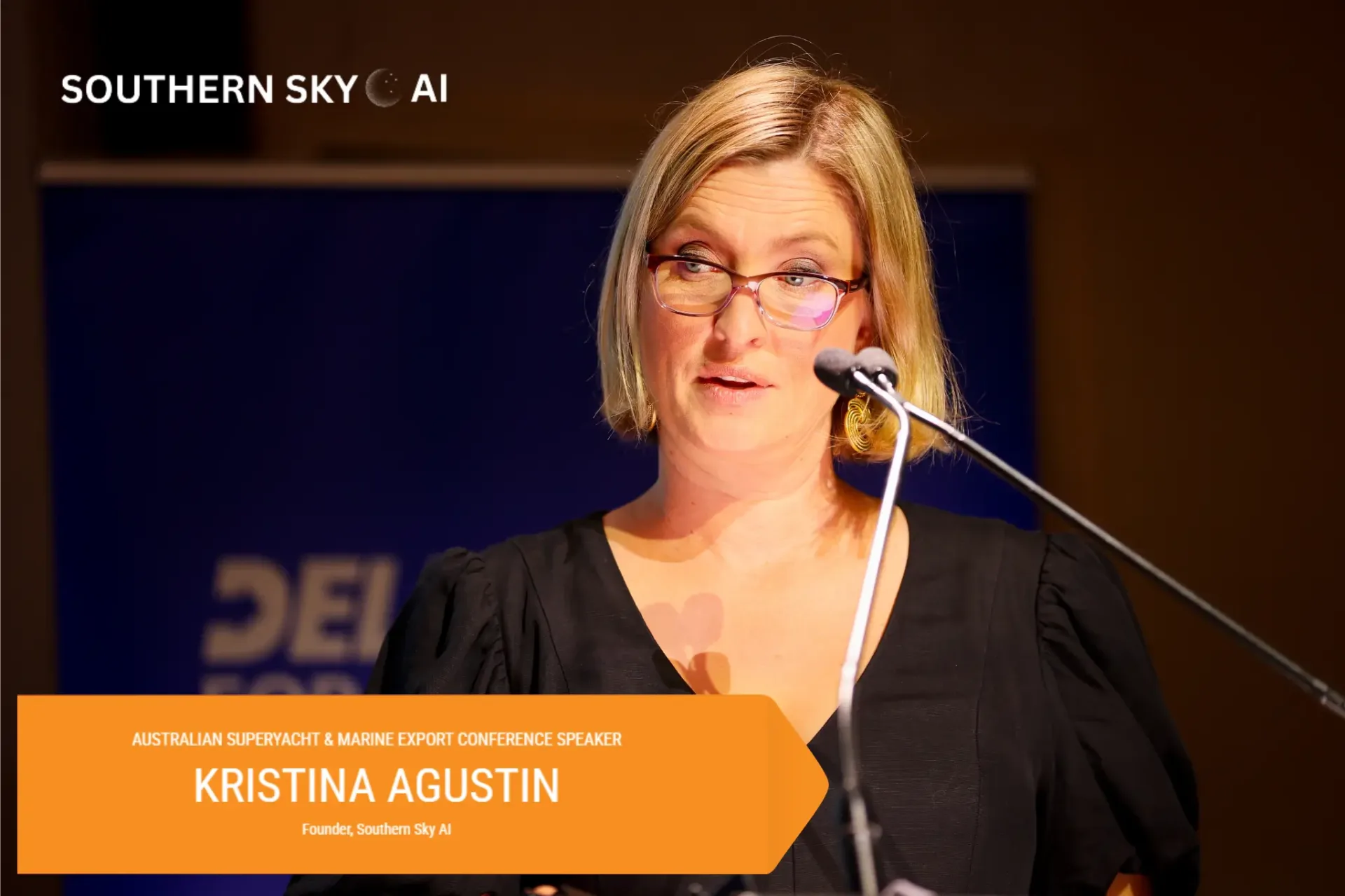
Kristina Agustin
Founder & Principal Digital Navigator, Southern Sky AI
20+ years in international superyacht and maritime operations. Legally trained (LLB, Graduate Diploma of Legal Practice). AI educator and consultant. ATSE Elevate Scholar 2026.
Start Here
Read your position in about five minutes. Twenty plain questions in, four readings back: the AI risks as they reach your business, the regulations that already apply to you, the cost of leaving that use unmanaged, and the moves that matter most, ranked from the top.
Get your baselineQuestions
The AI Baseline Report reads your position in about five minutes, and your answers pre-fill everything that follows.
Run the Baseline