

Perspective
The website your clients' AI assistant reads
July 28, 2026
The digital duel that turned into a discipline: AEO in plain words, and what an AEO-informed build changes on a maritime website.

Industries · Superyacht Engineering
Every system in your engine room carries a manual, a log and a named control. AI came aboard without any of the three.
The guests fly out and your season starts: everything that broke over six weeks of charter is now yours, plus the survey file, plus the handover you owe your rotation. Somewhere in the middle of that, your second is troubleshooting the aft genset with a chatbot, because pasting the fault code in is faster than finding the manual. Fair enough. Except the answer might be wrong in a way that costs a bearing, the fault history he pasted describes this vessel and where it's been, and nothing on the noticeboard says which tools are approved, what never goes into them, or who checks machine-drafted text before it goes into the PMS or a warranty claim. Every other system aboard was commissioned before the department trusted it. AI can run the same way: tools listed, limits written, a review step in the routine. It starts with knowing your position.
Prefer to talk it through first? .




The record so far
tracked across 25 jurisdictions
Every founding document reviewed by the legally trained founder before delivery.
Documents usually within two business days.
Training certificates independently verifiable at southernsky.ai/verify.
6,174
vessels over 30 metres worldwide, and on the fleet under 40 metres the engineer often works alone
90%
of chief engineers hold time-for-time rotation, the highest of any department aboard
€11,479
the average chief engineer month on the 40 to 100 metre fleet
Start Here
Start with where you stand. The AI Baseline Report reads your position in about five minutes, and your answers pre-fill everything that follows.
Run the BaselineWhere this sits for you
Five modes make up an engineering year: guests aboard, the repair season after they leave, the yard, the handover, and underneath all of it the record you sign. The pressures below are ranked the way engineers describe them. Where a written AI position changes one, the card says how; where it doesn't, the card says that too.
Charter ends, the rest of the crew wind down, and your list is just getting started: this is when everything that broke during the season gets fixed. That cycle burns full-time engineers out fast, which is why the department won time-for-time rotation before any other aboard. No document changes that arithmetic, and this page won't claim one does. What a written AI position does reach is what happens inside those weeks: the records, the handover, and the tools your team leans on under time pressure.
Rotation splits the vessel's technical memory between two heads, and the industry admits the mechanism is weak: engineering handovers have no standard industry format, and quality rests on individual diligence rather than the vessel's system. What walks off the passerelle with an outgoing engineer gets paid for twice, in re-diagnosed faults, re-ordered parts and documentation chains that weaken a warranty claim. The knowledge is the vessel's asset; the record of it usually isn't kept anywhere the vessel owns.
A part that reaches a Mediterranean marina in three to five days can take two to six weeks to reach a Caribbean or Pacific anchorage, and the freight sometimes costs more than the part. Reactive provisioning pays twice: rush charges on the way in, operational delay while you wait. Governance doesn't move freight, and nothing on this page claims it does; cleaner records help reordering and warranty discipline at the margin, and that's the most that can be said.
PMS entries, the defect list, running hours, bunkering paperwork, the Oil Record Book with its three-year retention and the master's countersignature, class and flag survey files, hours of rest. The classification literature's standing finding is that the most common survey deficiencies could have been identified months earlier by systematic pre-survey inspection, which makes the record the survey. Your signature sits on more legally consequential pages each week than any other crew member's except the master's.
Below roughly 100 metres there's rarely a cabin for both an ETO and an AV/IT specialist, so the owner's network, the entertainment stack and the Starlink estate default to you. The industry names it a skills shortage more than a people shortage: guests judge the boat by the Wi-Fi, and the estate came with no course attached. The same pattern, new estate and no syllabus, is now repeating with AI tools.
MTU's Go! platforms and Cat VisionLink stream engine health, hours and fuel data ashore, and class societies are moving survey evidence into digital channels. Useful diagnostics, with a standing question underneath: machinery data describes where this vessel goes and when, on an owner whose NDA covers exactly that. The vessel-side answer, which telemetry leaves, to whom, under what agreement, is a line most programmes haven't yet had a reason to put in writing.
Documented Work
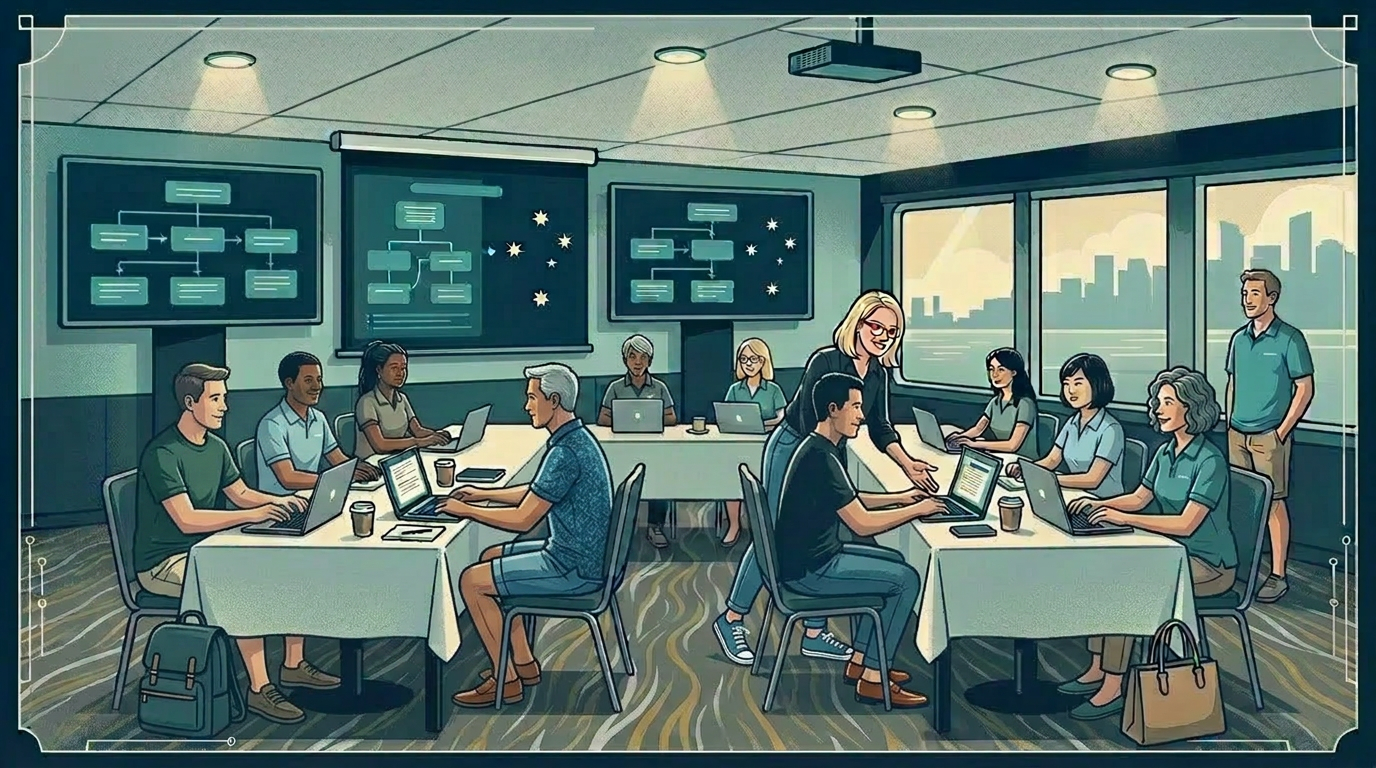
3 role-based workshop days, designed from a 12-department audit · 18 people certified, from maintenance and marine to finance and the executive team · Every participant left with a working AI setup and a reusable Skill built on a real task from their own role · Weeks later, reported publicly by the client: the team using AI more, sharing wins, and a real shift in the day to day
A twelve-department audit produced three role-based workshop days that certified eighteen people across ten departments, with the CHART quality method and the data rule embedded across the team and every certificate carrying a public verification page.
Read full engagement
One-day executive foundation session, delivered one-on-one, designed around a tightly controlled corporate IT environment where every tool runs in the browser · A monthly management accounting and insurer reporting workflow, sixteen reports each month, run end to end through the CHART quality method and captured as a reusable skill · A take-home toolkit and a short explainer video, so everything built on the day stays usable after it
A one-day, one-on-one foundation session with a senior executive in the marine insurance sector: a governed AI platform with a commercial data agreement behind it, a working environment built from the executive's own context, and a monthly reporting workflow of sixteen insurer reports run end to end and captured as a reusable skill.
Read full engagementThe Opportunity
Documented, product by product, with the marketing separated from the fleet. Here's what's shipping, and what isn't yet.
AI on the OEM manuals
YachtWave's AI Mechanic 4.0 pairs GPT-5 reasoning with a database of OEM technical manuals, returning vessel-specific troubleshooting cross-referenced to official OEM steps, and markets itself on reducing hallucination risk against general-purpose AI. Trade coverage describes the capability as answers pulled from all systems manuals in seconds; the checking is still a person's job.
AI inside yacht-management apps
YachtWyse ships metered AI diagnostic queries and AI-powered OCR on receipts and invoices inside its yacht-management tiers. Small, practical, and already in engineers' hands: paperwork capture and first-pass diagnostics, with the engineer's judgment untouched.
Vessel memory aimed at the handover
CelesteOS runs alongside the existing PMS and builds searchable, linked handover records continuously as engineers work, in pilot on vessels as of mid-2026. Early-stage, and pointed at the department's quietest failure point: the knowledge that leaves with a rotation.
OEM telemetry and condition-based maintenance
MTU's Go!Act and Go!Manage put remote engine monitoring, maintenance scheduling and spares availability on the manufacturer's side of the link, and Cat VisionLink streams engine health and fuel telemetry to the cloud. Condition-based scheduling through OEM channels is the predictive maintenance that exists today.
Class societies reading records by machine
DNV, the classification society, runs remote surveys by live video link and has completed in-water surveys by ROV; Bureau Veritas, another class society, runs AI and AR augmented surveys; ABS, the American classification society, completed a pilot applying AI to corrosion and coating-breakdown detection; RINA, the Italian classification society, is developing electronic logbooks surveyors can prepare from ashore. The evidence chain you maintain is increasingly read by machines before a surveyor steps aboard, which raises the price of a thin record another notch.
What the PMS you key every day still doesn't do
The 2026 comparisons of yacht-management software note that most platforms carry no AI diagnostics and no predictive maintenance yet, while shore-side management firms market both as current practice. On the 30 to 60 metre fleet, AI is arriving through OEM channels and vendor roadmaps ahead of the PMS itself. The direction is set; the tools on your desk haven't caught up to the brochures.
Where to start
The order below follows how an engineering year runs and who signs what. Training is yours to take: leave blocks are when tickets get upgraded, and this course fits the same windows. The Baseline is yours to send: five minutes, and the readings travel to your captain, because that's the direction a technical proposal moves. Essentials is the vessel's to adopt: you champion it the way you'd champion any system that needs commissioning, and your captain or management company carries it from there.
The engine department, or the whole crew, to one standard: what current AI tools do well against manuals and fault histories, where hallucination risk sits in technical answers and how to bound it, what never leaves the boat (owner and guest data, vessel movements, OEM-licensed documentation), and how a review step folds into the PMS entries and reports you already write. Delivered in a yard period or alongside, the same slot as every other course, with certificates independently verifiable at southernsky.ai/verify. You've priced your own ticket ladder; this one takes a day.
Twenty plain questions, about five minutes, four readings back: the AI risks as they reach your engine room, the regulations that already apply, the cost of leaving crew use unmanaged, and the moves that matter most, ranked from the top. Send the results to your captain; that's what they're built for.
The vessel's written AI position, drafted in SMS format, the format the DPA reads on sight: approved tools named, including whether a manual-lookup AI is sanctioned; protected information listed, from owner and guest data to vessel movements, condition data and OEM-licensed manuals; a review step before machine-drafted text enters the PMS, a survey file, a warranty claim or an owner report; and the telemetry question answered in writing. Comes with a prompt library, 90 days of crew education, a recorded briefing of the vessel's position, a 30-minute walkthrough call and 30 days of email support. Purchased by the vessel: USD $690 for the founding twenty, then USD $990. Your part is the case upward, and the Baseline readings are that page. If a management company runs your programme, their page is here.
Tools and rules move; the vessel's position moves with them. The same logic as revalidation. USD $69 a month, held by the vessel.
The outputs are governance artifacts, drafted for review and adoption inside your own organisation; where legal advice is needed, it belongs with qualified counsel.
Reading
July 28, 2026
The digital duel that turned into a discipline: AEO in plain words, and what an AEO-informed build changes on a maritime website.
July 21, 2026
Five documented builds from the Log Book, and what deployment actually means: tools handed over working, configured to your systems, with documentation.

July 17, 2026
What an insurer, auditor or client reads for in an AI use policy: twelve questions that test any draft, template-started or written from scratch, before someone asks to see it.

Written from inside your world
Kristina Agustin
Founder & Principal Digital Navigator, Southern Sky AI
20+ years in international superyacht and maritime operations. Legally trained (LLB, Graduate Diploma of Legal Practice). AI educator and consultant. ATSE Elevate Scholar 2026.
Questions
The AI Baseline Report reads your position in about five minutes, and your answers pre-fill everything that follows.