
AI for superyacht engineers.
Useful tools for technical information, records and handovers.
An introductory conversation ↗Start with the work.
Make AI useful.
Three areas to explore in your AI Blueprint.
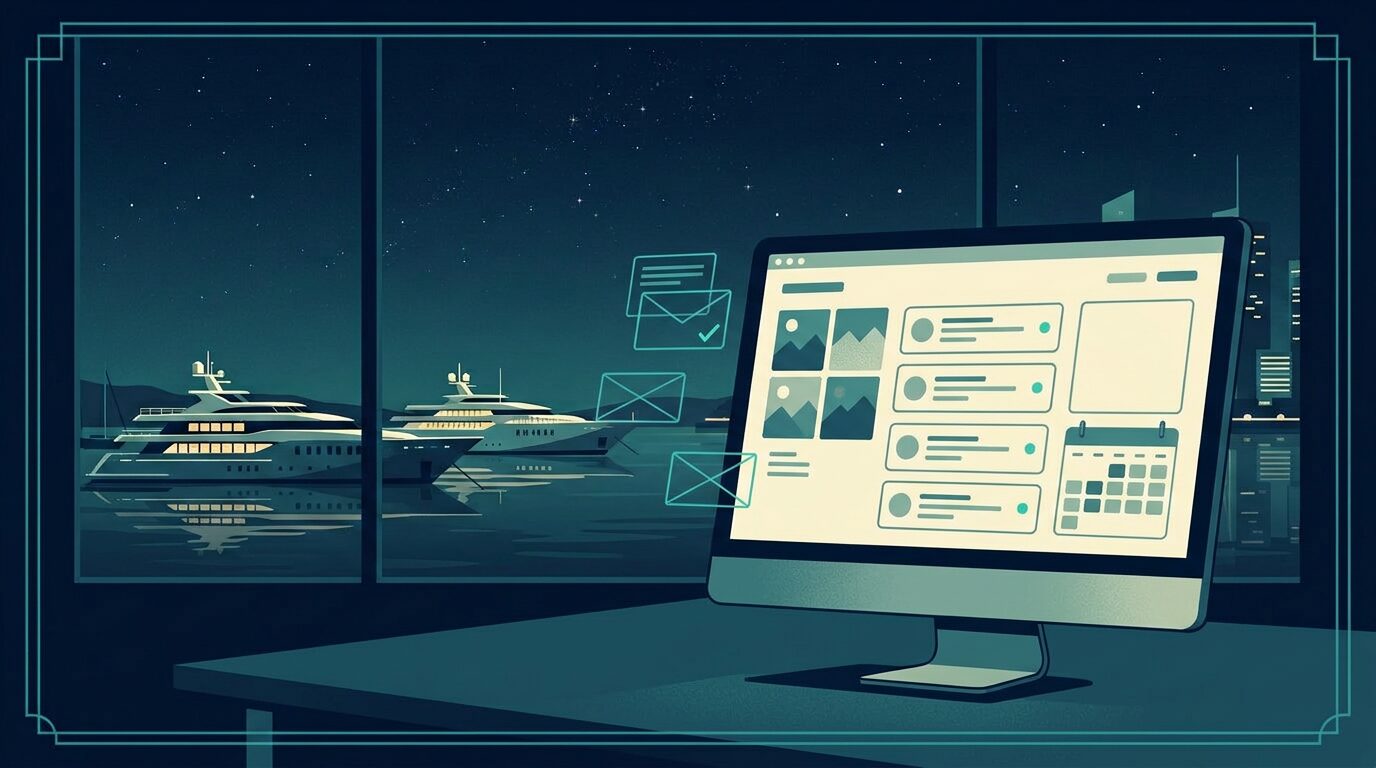
A marketing assistant for a maritime team.
An assistant that drafts social posts, email campaigns and newsletter items for review.
Read the project ↗Your industry.
Your context.
Open the guidance relevant to your organisation.
Regional context
The season stages through Fort Lauderdale, the yards are running near capacity, and the record you sign is the one US authorities read. What AI is already doing in the engine room, the pressures with American texture, and the safest way to keep the record yours.
Prefer to talk it through first? Book an introductory conversation.
Experience and approach
The record so far
221 obligations tracked across 25 jurisdictions
- Every founding document reviewed by the legally trained founder before delivery.
- Documents usually within two business days.
- Training certificates independently verifiable at southernsky.ai/verify.
Figures as published on southernsky.ai, reviewed September 2026.
Regional context
vessels over 30 metres worldwide, and on the fleet under 40 metres the engineer often works alone
of chief engineers hold time-for-time rotation, the highest of any department aboard
the chief engineer month at 30 to 40 metres, rising to US$15,000+ at 80 metres and above
Figures as published on southernsky.ai, reviewed September 2026.
Industry context
Five modes make up an engineering year: guests aboard, the repair season after they leave, the yard, the handover, and underneath all of it the record you sign. The pressures below are ranked the way engineers describe them. Where a written AI position changes one, the card says how; where it doesn't, the card says that too.
The record that answers for you here
The United States enforces MARPOL, the international marine pollution convention, through its own statute, and the prosecutions on the public record rest almost entirely on false entries in the Oil Record Book rather than on anything that happened in US waters. That puts the engineer who keeps a true, consistent book in the strongest position a US port can offer: the record you already sign is the evidence that speaks for you. As AI tools start touching logs and reports, a written review step keeps machine-drafted text out of a legally signed book until a person has checked it, which keeps that record fully yours.
Ninety-four percent booked, and a hurricane clock
Lauderdale Marine Center ran at a reported 94 percent utilisation through 2025, recruitment-sector reporting describes Broward's specialist trades as booked out against demand, and hurricane season compresses yard decisions between 1 June and 30 November. For the biggest hulls the east coast answer is Savannah, with captains routed between Georgia and West Palm Beach by slot availability. A season like that rewards the engineer who arrives with the worklist, the records and the parts list already in order, because the yard has no slack to absorb a scramble.
Rotation through the B1/B2 desk
Non-US crew serve aboard foreign-flagged vessels in US waters, and work aboard in US shipyards, on B1/B2 visas, never on a US payroll or for a US employer. Issuance and border practice have tightened and are applied case by case, so rotation planning treats the arrival date as a variable. What the vessel controls is continuity: a handover record complete enough that the engine room holds its shape when a rotation date moves.
The engine-room AI ships from this coast
YachtWave, the Sarasota developer of AI Mechanic, shipped version 4.0 in March 2026, pairing GPT-5 reasoning with a database of OEM technical manuals for vessel-specific troubleshooting. ABS, the Houston-based classification society, has piloted AI detection of corrosion and coating breakdown, and Caterpillar's VisionLink streams engine telemetry to the cloud. The tools reaching US engine rooms are real and documented; the step that stays aboard is naming which of them are approved, and who checks a machine answer before anyone torques a bolt on it.
The guests leave and the repair season starts
Charter ends, the rest of the crew wind down, and your list is just getting started: this is when everything that broke during the season gets fixed. That cycle burns full-time engineers out fast, which is why the department won time-for-time rotation before any other aboard. No document changes that arithmetic, and this page won't claim one does. What a written AI position does reach is what happens inside those weeks: the records, the handover, and the tools your team leans on under time pressure.
Handovers with no standard behind them
Rotation splits the vessel's technical memory between two heads, and the industry admits the mechanism is weak: engineering handovers have no standard industry format, and quality rests on individual diligence rather than the vessel's system. What walks off the passerelle with an outgoing engineer gets paid for twice, in re-diagnosed faults, re-ordered parts and documentation chains that weaken a warranty claim. The knowledge is the vessel's asset; the record of it usually isn't kept anywhere the vessel owns.
Spares and the arithmetic of remoteness
A part that reaches a Mediterranean marina in three to five days can take two to six weeks to reach a Caribbean or Pacific anchorage, and the freight sometimes costs more than the part. Reactive provisioning pays twice: rush charges on the way in, operational delay while you wait. Governance doesn't move freight, and nothing on this page claims it does; cleaner records help reordering and warranty discipline at the margin, and that's the most that can be said.
The record you sign
PMS entries, the defect list, running hours, bunkering paperwork, the Oil Record Book with its three-year retention and the master's countersignature, class and flag survey files, hours of rest. The classification literature's standing finding is that the most common survey deficiencies could have been identified months earlier by systematic pre-survey inspection, which makes the record the survey. Your signature sits on more legally consequential pages each week than any other crew member's except the master's.
The AV/IT estate that arrived without a syllabus
Below roughly 100 metres there's rarely a cabin for both an ETO and an AV/IT specialist, so the owner's network, the entertainment stack and the Starlink estate default to you. The industry names it a skills shortage more than a people shortage: guests judge the boat by the Wi-Fi, and the estate came with no course attached. The same pattern, new estate and no syllabus, is now repeating with AI tools.
Telemetry that already leaves the boat
MTU's Go! platforms and Cat VisionLink stream engine health, hours and fuel data ashore, and class societies are moving survey evidence into digital channels. Useful diagnostics, with a standing question underneath: machinery data describes where this vessel goes and when, on an owner whose NDA covers exactly that. The vessel-side answer, which telemetry leaves, to whom, under what agreement, is a line most programmes haven't yet had a reason to put in writing.
Figures as published on southernsky.ai, reviewed September 2026.
Tools and examples
Documented, product by product, with the marketing separated from the fleet. Here's what's shipping, and what isn't yet.
YachtWave's AI Mechanic 4.0 pairs GPT-5 reasoning with a database of OEM technical manuals, returning vessel-specific troubleshooting cross-referenced to official OEM steps, and markets itself on reducing hallucination risk against general-purpose AI. Trade coverage describes the capability as answers pulled from all systems manuals in seconds; the checking is still a person's job.
AI inside yacht-management apps
YachtWyse ships metered AI diagnostic queries and AI-powered OCR on receipts and invoices inside its yacht-management tiers. Small, practical, and already in engineers' hands: paperwork capture and first-pass diagnostics, with the engineer's judgment untouched.
Vessel memory aimed at the handover
CelesteOS runs alongside the existing PMS and builds searchable, linked handover records continuously as engineers work, in pilot on vessels as of mid-2026. Early-stage, and pointed at the department's quietest failure point: the knowledge that leaves with a rotation.
OEM telemetry and condition-based maintenance
MTU's Go!Act and Go!Manage put remote engine monitoring, maintenance scheduling and spares availability on the manufacturer's side of the link, and Cat VisionLink streams engine health and fuel telemetry to the cloud. Condition-based scheduling through OEM channels is the predictive maintenance that exists today.
Class societies reading records by machine
DNV, the classification society, runs remote surveys by live video link and has completed in-water surveys by ROV; Bureau Veritas, another class society, runs AI and AR augmented surveys; ABS, the American classification society, completed a pilot applying AI to corrosion and coating-breakdown detection; RINA, the Italian classification society, is developing electronic logbooks surveyors can prepare from ashore. The evidence chain you maintain is increasingly read by machines before a surveyor steps aboard, which raises the price of a thin record another notch.
What the PMS you key every day still doesn't do
The 2026 comparisons of yacht-management software note that most platforms carry no AI diagnostics and no predictive maintenance yet, while shore-side management firms market both as current practice. On the 30 to 60 metre fleet, AI is arriving through OEM channels and vendor roadmaps ahead of the PMS itself. The direction is set; the tools on your desk haven't caught up to the brochures.
- 01AI on the OEM manualsYachtWave's AI Mechanic 4.0 pairs GPT-5 reasoning with a database of OEM technical manuals, returning vessel-specific troubleshooting cross-referenced to official OEM steps, and markets itself on reducing hallucination risk against general-purpose AI. Trade coverage describes the capability as answers pulled from all systems manuals in seconds; the checking is still a person's job.
- 02AI inside yacht-management appsYachtWyse ships metered AI diagnostic queries and AI-powered OCR on receipts and invoices inside its yacht-management tiers. Small, practical, and already in engineers' hands: paperwork capture and first-pass diagnostics, with the engineer's judgment untouched.
- 03Vessel memory aimed at the handoverCelesteOS runs alongside the existing PMS and builds searchable, linked handover records continuously as engineers work, in pilot on vessels as of mid-2026. Early-stage, and pointed at the department's quietest failure point: the knowledge that leaves with a rotation.
- 04OEM telemetry and condition-based maintenanceMTU's Go!Act and Go!Manage put remote engine monitoring, maintenance scheduling and spares availability on the manufacturer's side of the link, and Cat VisionLink streams engine health and fuel telemetry to the cloud. Condition-based scheduling through OEM channels is the predictive maintenance that exists today.
- 05Class societies reading records by machineDNV, the classification society, runs remote surveys by live video link and has completed in-water surveys by ROV; Bureau Veritas, another class society, runs AI and AR augmented surveys; ABS, the American classification society, completed a pilot applying AI to corrosion and coating-breakdown detection; RINA, the Italian classification society, is developing electronic logbooks surveyors can prepare from ashore. The evidence chain you maintain is increasingly read by machines before a surveyor steps aboard, which raises the price of a thin record another notch.
- 06What the PMS you key every day still doesn't doThe 2026 comparisons of yacht-management software note that most platforms carry no AI diagnostics and no predictive maintenance yet, while shore-side management firms market both as current practice. On the 30 to 60 metre fleet, AI is arriving through OEM channels and vendor roadmaps ahead of the PMS itself. The direction is set; the tools on your desk haven't caught up to the brochures.
Figures as published on southernsky.ai, reviewed September 2026.
Related reading
AI in Superyacht Marketing: Insights from the USSA Superyacht Summit
March 28, 2026
Insights from the USSA Superyacht Summit AI in Marketing Panel, West Palm Beach, March 2026. Digital avatars, AEO, data governance, and what structured AI adoption looks like in practice.
Read full engagement ↗ISS Leadership Series: AI in Yachting
March 31, 2026
Structured AI adoption means holding five dimensions simultaneously: vision, discovery, security, efficiency, and accountability. Insights from the ISS Education Committee panel in West Palm Beach, March 2026.
Read full engagement ↗ISS Leadership Series: AI in Yachting (Panel Recording)
Read full engagement ↗March 31, 2026
Full recording of the ISS Education Committee Leadership Series panel on AI in Yachting, moderated by Kristina Agustin in West Palm Beach, March 2026. Panelists: Jake Lazarus, Sara Shake, Claire Hagen, Alistair Callender, and Christina Norris.
Figures as published on southernsky.ai, reviewed September 2026.
About Kristina
Founder, Southern Sky AI
20+ years in international superyacht and maritime operations. Admitted Lawyer (Supreme Court of NSW). ATSE Elevate Scholar 2026, completing a Master of Artificial Intelligence.
Figures as published on southernsky.ai, reviewed September 2026.