The twelve questions an AI use policy has to answer
July 17, 2026
What an insurer, auditor or client reads for in an AI use policy: twelve questions that test any draft, template-started or written from scratch, before someone asks to see it.
Industries · Marine Insurance Broking
Your coastal book renews through the surplus lines market now, AI sections are appearing on the applications, and twenty-four states have told your carriers to document their AI systems. That diligence flows down the chain to the desks that place with them.
The renewal file keeps taking longer. Commission consent added a step in July 2025, the market is remarketing itself as capacity returns, and the same three people carry a book that grew while the profession aged. NIBA's own numbers say brokers under thirty are eleven percent of the profession now, the smallest share on record.
Where are you based?
Where this sits for you
Meanwhile the tools arrived quietly: a pre-renewal summary from COVA here, a policy comparison there, a junior pasting client details into ChatGPT because it was faster. ASIC has already named the pattern, adoption running ahead of governance, and the licence obligations were yours throughout. There is a version of this where the admin lifts, the craft stays, and your file notes show who checked what before it reached the client. It starts with knowing your position.
The National Association of Insurance Commissioners, the standard-setting body of US state insurance regulators, issued its model bulletin on insurers' AI use in December 2023, and 24 states had adopted it by March 2025: each insurer runs a written AI program with governance and vendor oversight, and state insurance departments may request that documentation in examinations.
The New York Department of Financial Services' Circular Letter No. 7 of July 2024 goes further for underwriting and pricing: demonstrated actuarial validity, discrimination testing, a governance framework, and audit rights written into vendor contracts.
After consecutive hurricane years many generalist insurers exited marine lines, leaving the excess and surplus market the most consistent option for coastal marine property; into the 2026 season new carriers and MGAs are re-entering while catastrophe-exposed risks stay under stringent scrutiny.
CNA already sends supplemental AI questionnaires, professional-liability underwriters treat AI as a material risk factor, and AI-governance sections appeared on cyber applications through 2025 into 2026. The documented question sets are PI, E&O and cyber, and they reach your professional-services clients and your agency's own E&O renewal first.
The agent press has named the exposure plainly: an AI miscalculation or a chatbot's wrong coverage answer becomes the agency's E&O claim, and the standing advice is documented human review of AI output.
A shifting market means more remarketing per renewal, and the commission-consent steps added in July 2025 put a new compliance action inside every retail file. The desk absorbed the added work on flat headcount, which is exactly why renewal preparation is where AI tools reached broking first, ahead of any governance paperwork.
Brokers under thirty hold 11 percent of the profession, the smallest share on record, and senior brokers take four to six months to place. Fifty-eight percent of firms carry no formal succession plan while three quarters of owners expect to exit within a decade. In marine broking the craft knowledge of hulls, class and salvage sits in the fewest heads of all.
When one facility tightens appetite for waterfront storage, older hulls or cyclone-zone risks, the local options run thin, and Lloyd's minimums price out the small end. A Treasury-commissioned review found marinas unable to place all of their risk. You carry the client conversation either way.
Industry compliance spend runs to $3.5 billion a year, 8 to 10 percent of operating expenses, and the same obligations sit with a small brokerage without a compliance team: reportable situations, DDO reporting, code data returns, CPD tracking, and now ASIC's AI governance expectations under REP 798. The regulator has already named the pattern of adoption running ahead of governance.
Claims turnaround belongs to the insurer, and the daily inbox belongs to you: chasing assessors, parts and repairer shortages, surveyor availability on marine losses. In marine books the client relationship is generational, so a botched claim costs more than the file it sits in.
The Opportunity
On the US desk AI arrived renewal-first: summarising twelve months of client activity before the renewal conversation, comparing wordings on a remarketed placement, drafting claims chase correspondence, speeding data entry. The carrier side has moved further: AI exclusions are appearing in policy language, at least one cyber carrier underwrites third-party AI tool exposure explicitly, and the professional-lines questionnaires now ask how an insured governs its AI.
The standing advice from the agency press is documented human review of AI output, because a wrong coverage answer becomes the agency's E&O claim. A written AI policy, an approved-tools register and training records answer the carrier questionnaire, the downstream diligence the state bulletins set in motion, and your own E&O proposal form in one set.

Pre-renewal reports
COVA prepares the pre-renewal summary that historically took upwards of 30 minutes per file to understand a year of activity, cutting it to about 15, and the broker checks the summary before it reaches the client.
Policy and wordings comparison
COVA compares policy wordings across markets on a remarketed file, and the broker verifies the comparison before advising.
Market scans
COVA scans the market for alternative capacity when an incumbent moves, and the broker confirms appetite before presenting options.
Client-activity summaries
JAVLN summarises twelve months of client activity for renewal prep and halves the time, and the broker reads it against the file before the renewal conversation.
Claims correspondence
A chatbot drafts claims chase letters and correspondence, and the broker checks the agreed value, the lay-up warranty and the named-storm terms before it goes to the insurer or the client.
Data entry
Juniors use AI to speed data entry, under a rule naming what client detail may go into which tool.
These are the workflows the prompt library and training stand up, under the standard the AI use policy, approved-tools register and training records set, the same artefacts ASIC REP 798 looks for.
Your World
The US chain of diligence
USTwenty-four states have told your carriers to document their AI systems, and that diligence flows down the chain to the desks that place with them, with E&S applications arriving with an AI governance section attached.
Pre-renewal reports and market scans
Each renewal means a pre-renewal report and a market scan, and preparing one historically took upwards of 30 minutes per client before AI summarisation cut it to about 15.
25 CPD points a year
AUSNIBA members and QPIBs log 25 CPD points a year, including 5 regulatory and 1 ethics.
Brokers' sub-1% share
AUSAFCA complaints hit a record in 2025, and broker-related complaints are less than 1 percent of that total.
SCTP and JAVLN on the desk
AUSPlacement flows through the Steadfast Client Trading Platform, the desk runs on a broker management system such as JAVLN, and AI summarisation now arrives on top of both.
The AI question on the form
UKBrowne Jacobson published the professional indemnity proposal-form question "Where is AI being implemented within your business?", part of the PI, E&O and cyber question sets underwriters now run.
Hard-to-place waterfront risks
AUSPleasure-craft capacity sits with three or four facilities, and the Treasury review found two large marinas unable to place all of their risk.
The succession math
AUS58 percent of firms have no formal succession plan, 75 percent of owners expect to exit within a decade, and internal buy-ins need $2-5m the next generation does not have.
Lloyd's and SM&CR
UKNinety-three percent of Lloyd's managing agents now run or are building formal AI frameworks, and under SM&CR a named senior manager owns the AI-driven outcomes on the desk.
MAS built an AI risk toolkit
SGProject MindForge phase two concluded on 20 March 2026 with an AI Risk Management Toolkit for the financial sector, built by a consortium of 24 banks, insurers and capital-market firms.
Insurance Authority AI cohort
HKThe IA's AI Cohort Programme launched in August 2025 with seven leading insurers building an AI Centre of Excellence in Hong Kong, while licensed intermediaries carry 15 CPD hours per assessment period under GL24, three of them on ethics or regulations.
Lloyd's Asia scale
SGLloyd's Asia, established in Singapore in 1999, is the Lloyd's market's largest underwriting platform outside London; the PI, E&O and cyber question sets London syndicates script reach Singapore-placed business as that capacity rolls out (arrival inferred from market structure, not separately documented in Asia).
Where to start
The brokerage's own position in five minutes.
The working start for the brokerage: the AI policy, approved-tools register and training pathway a licensee can put in front of ASIC, a PI insurer, or a network audit, with a prompt library that starts the first governed workflow on the renewal desk, 90 days of team education, a recorded briefing, a 30-minute walkthrough call and 30 days of email support. USD $690 founding, then USD $990.
The whole desk to one standard, certificates verifiable at southernsky.ai/verify.
Your marine clients face the same questions; there is a pack for that.
Documented Work

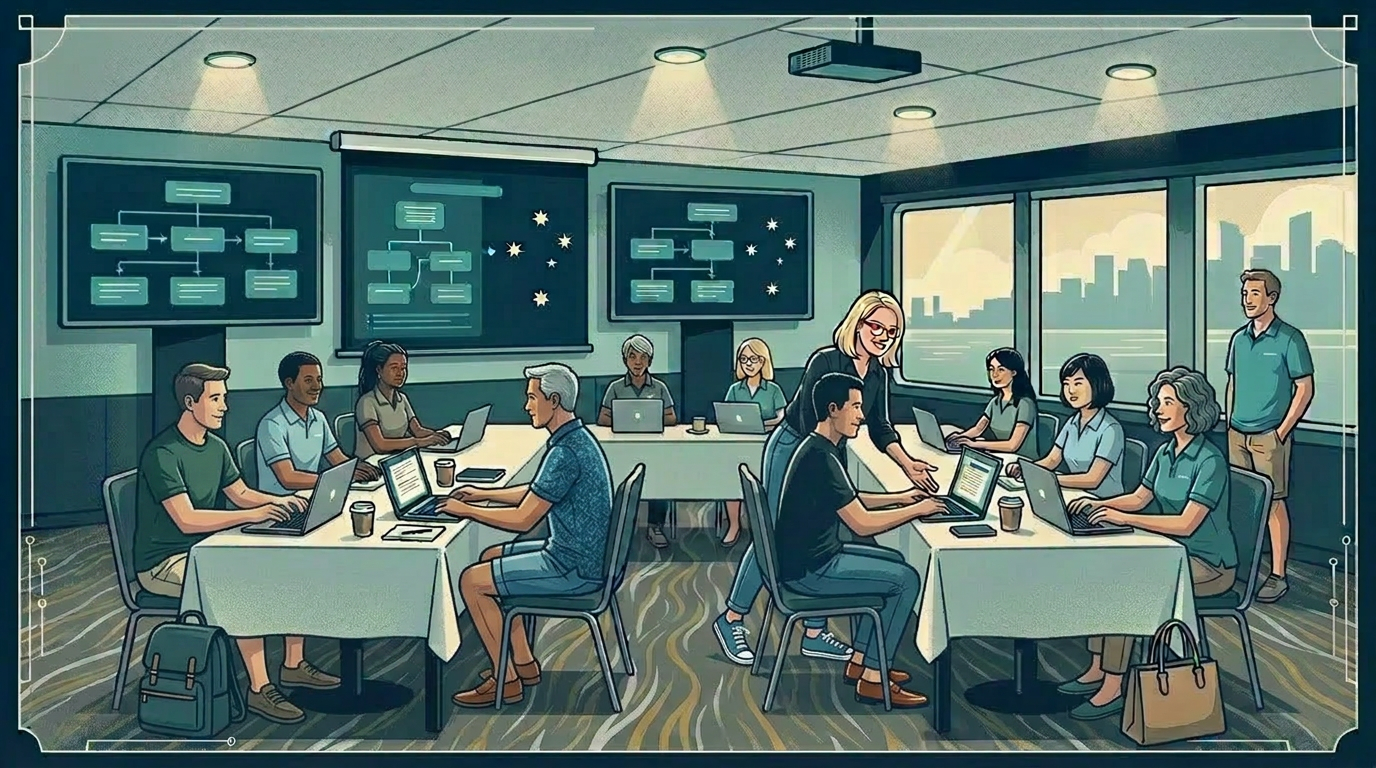
3 role-based workshop days, designed from a 12-department audit · 18 people certified, from maintenance and marine to finance and the executive team · Every participant left with a working AI setup and a reusable Skill built on a real task from their own role · Weeks later, reported publicly by the client: the team using AI more, sharing wins, and a real shift in the day to day
A twelve-department audit produced three role-based workshop days that certified eighteen people across ten departments, with the CHART quality method and the data rule embedded across the team and every certificate carrying a public verification page.
Read full engagement
2,040 indexable pages · 1,645 articles migrated · 146 member and partner listings · Over 1 million requests a month · ChatGPT reading 9,400+ pages in a single day · Cited and fetched live in ChatGPT daily
The Asia-Pacific Superyacht Association (APSA) was running a static HTML website carrying close to fifteen years of content. Southern Sky AI rebuilt it as a platform of 2,040 indexable pages, 1,645 migrated articles, a 146-listing member and partner directory, and 47 events, with structured schema.org data on every page and an llms.txt file. The site now handles over a million requests a month, is cited as a source in ChatGPT, and is read live by AI assistants every day, and in one recent day, ChatGPT's crawler alone read more than 9,400 pages.
Read full engagementReading

2026
Federal and state instruments reaching US marine operators.

2026
The regulators, the obligations, and the moves that matter first.

July 17, 2026
What an insurer, auditor or client reads for in an AI use policy: twelve questions that test any draft, template-started or written from scratch, before someone asks to see it.

Written from inside your world
Kristina Agustin
Founder & Principal Digital Navigator, Southern Sky AI
20+ years in international superyacht and maritime operations. Legally trained (LLB, Graduate Diploma of Legal Practice). AI educator and consultant. ATSE Elevate Scholar 2026.
Start Here
Read your brokerage's position in about five minutes. Twenty plain questions in, four things back: the risks as they reach your desk, the regulations that already apply to you, the cost of leaving it unmanaged, and the moves that matter most, ranked.
Get your baselineQuestions
The AI Baseline Report reads your position in about five minutes, and your answers pre-fill everything that follows.
Run the Baseline